
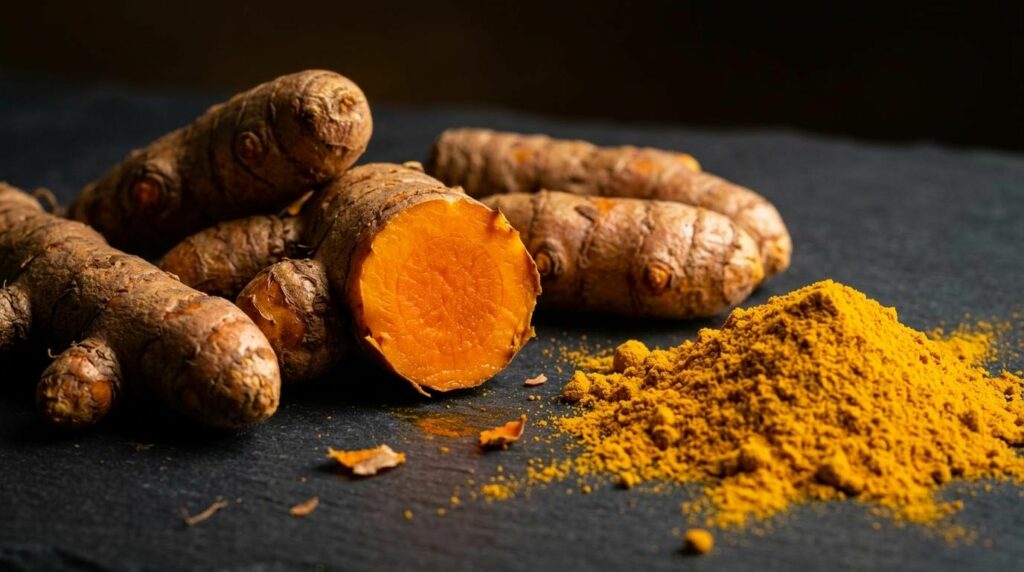
Turmeric is one of the most researched natural anti-inflammatory ingredients on the planet. If you’re managing uric acid levels, it deserves a place in your toolkit.
Here’s the problem.
Most of what you read about turmeric online is vague, overhyped, or flat-out wrong about dosage. And the vast majority of turmeric supplements on the market are poorly absorbed, which means you’re paying for something your body can barely use.
Here’s what turmeric actually does for uric acid, what the research shows, and how to make sure you’re getting a form that works.
What Turmeric Does (Two Key Mechanisms)
Turmeric’s active compound is curcumin. It’s the thing that gives turmeric its deep yellow colour and is responsible for most of the health benefits.
For uric acid support, curcumin works through two main pathways.
1. Anti-inflammatory action
When uric acid levels get too high, crystals can form in your joints. Your immune system responds to these crystals with inflammation, and that’s what causes the pain, swelling, and heat during a flare-up.
Curcumin is a potent inhibitor of NF-kB, one of the master switches that controls your body’s inflammatory response. Research has shown it can reduce the production of inflammatory cytokines (the chemical messengers that amplify inflammation).
In practical terms, it helps manage the inflammatory response that uric acid crystals trigger.
2. Xanthine oxidase inhibition
This is the lesser-known mechanism, but it’s significant.
Xanthine oxidase is the enzyme your body uses to produce uric acid. Several studies have shown that curcumin can inhibit this enzyme, meaning your body may produce less uric acid in the first place.
This is the same mechanism that pharmaceutical drugs like allopurinol target, though curcumin’s effect is milder. It adds another layer of support rather than replacing medication.
What the Research Shows
Turmeric isn’t folk medicine. There’s real science here.
Curcumin and xanthine oxidase
Research has examined curcumin’s effect on xanthine oxidase activity and found that curcumin demonstrated significant inhibitory effects on the enzyme, supporting reduced uric acid production. The mechanism was dose-dependent, meaning more curcumin produced a stronger effect.
Curcumin and uric acid-induced inflammation
Research has investigated curcumin’s impact on uric acid-induced inflammation in kidney cells. Findings showed that curcumin suppressed the NLRP3 inflammasome pathway, one of the key inflammatory cascades triggered by uric acid crystals. This is important because it shows curcumin acts on the underlying mechanism, not just the symptoms.
Shen & Ji (2012)
This review examined curcumin’s anti-inflammatory properties across multiple pathways. The findings confirmed that curcumin modulates NF-kB, COX-2, and various inflammatory cytokines, providing broad-spectrum anti-inflammatory support.
A randomised controlled trial found that curcumin supplementation (at sufficient dosages with enhanced bioavailability) significantly reduced markers of systemic inflammation in participants.
The pattern across the research is consistent: curcumin supports both reduced uric acid production and a healthier inflammatory response.
The Bioavailability Problem
Here’s where most people go wrong with turmeric. And where most supplement companies either don’t know or don’t care.
Plain turmeric powder (the stuff you use in cooking) contains only about 3% curcumin by weight. And even that curcumin is very poorly absorbed by your body. Studies have shown that plain curcumin has extremely low bioavailability; most of it passes straight through your digestive system without being absorbed.
This means:
- Sprinkling turmeric on your food is great for flavour but does almost nothing for your uric acid levels.
- Cheap turmeric capsules filled with plain turmeric powder are mostly a waste of money.
- Even some “curcumin” supplements use forms that aren’t well absorbed.
What you need is a standardised extract.
Specifically, look for:
- 95% curcuminoids. This means the extract has been concentrated to contain 95% active curcumin compounds, compared to 3% in raw turmeric. That’s a massive difference.
- Piperine (black pepper extract). Studies have shown that piperine increases curcumin absorption by up to 2,000%. If your turmeric supplement doesn’t contain piperine or another bioavailability enhancer, you’re absorbing very little.
Without standardisation and a bioavailability enhancer, you’re essentially paying for expensive yellow powder.
How Much Do You Need?
Dosage matters. Too little and you won’t see results. The research gives us good guidance:
- For general anti-inflammatory support: 100-500mg of standardised curcumin extract (95% curcuminoids) daily.
- For targeted uric acid support as part of a multi-ingredient formula: 25-100mg of a high-quality 95% extract is effective, particularly when combined with other ingredients that work through complementary pathways.
Curcumin doesn’t need to do all the heavy lifting on its own. When it’s part of a well-designed formula with ingredients that address uric acid from multiple angles, a moderate dose of high-quality extract is effective.
URICAH uses Turmeric Rhizome 95% Extract at 25mg per serve.
This is a concentrated, standardised extract. It’s included alongside 13 other active ingredients that each target a specific aspect of uric acid management.
How Turmeric Works With Other Ingredients
Turmeric is good on its own. It’s better in combination.
The most effective approach to uric acid management targets multiple pathways simultaneously. Here’s how turmeric fits into the bigger picture:
- Tart cherry extract provides additional anti-inflammatory support through anthocyanins and also inhibits xanthine oxidase. Two ingredients targeting the same enzyme through different mechanisms.
- Celery seed extract supports uric acid excretion through the kidneys. While turmeric helps reduce production and manage inflammation, celery seed helps flush uric acid out.
- Chanca piedra adds kidney support and has its own xanthine oxidase inhibiting properties.
- Bromelain provides complementary anti-inflammatory action through a completely different mechanism (proteolytic enzyme activity).
Single-ingredient turmeric supplements can help. You’ll get better results from a formula that combines turmeric with ingredients that address the problem from different angles.
Read about natural ways to support healthy uric acid levels →
Learn what to look for in a uric acid supplement →
What to Watch Out For
Not all turmeric supplements are created equal. Here’s what to avoid.
Plain turmeric powder in capsules.
Low curcumin content, poor absorption. Often sold cheaply and marketed as “turmeric supplement.” Check the label. If it says “turmeric powder” rather than “turmeric extract” or “curcumin extract,” skip it.
No standardisation listed.
If the label doesn’t tell you the percentage of curcuminoids, you don’t know what you’re getting. Look for 95% curcuminoids.
Proprietary blends.
Some companies hide turmeric inside a proprietary blend where you can’t tell how much is actually included. If you can’t see the exact dosage, you can’t evaluate whether it’s enough.
No bioavailability enhancer.
Without piperine or another absorption technology, you’re absorbing a fraction of the curcumin. Check for black pepper extract or piperine on the ingredient list.
URICAH lists every ingredient and every dosage clearly on the label. No proprietary blends. No guessing. 14 ingredients including Turmeric Rhizome 95% Extract at 25mg, backed by a 90-day money-back guarantee and 2,200+ customer reviews.
The Bottom Line
Turmeric is a genuine, research-backed ingredient for uric acid support. It fights inflammation through multiple pathways and may help reduce uric acid production by inhibiting xanthine oxidase.
Form matters enormously.
You need a standardised 95% curcuminoid extract with a bioavailability enhancer. Plain turmeric powder won’t cut it. And you’ll get the best results when it’s combined with other ingredients that target uric acid from different angles.
Don’t waste money on cheap turmeric capsules. Get the right form, at the right dose, in the right combination.
This article is for informational purposes only and is not intended as medical advice. Consult your healthcare provider before making changes to your health routine.

URICAH! Uric Acid Support
4.85 / 5
read 2,294 customer reviews
$39 NZDTHIS IS YOUR URICAH MOMENT
URICAH provides natural support for healthy uric acid levels.
Our 14 potent, natural ingredients support the body’s normal uric acid levels, supporting joint mobility and function.
URICAH!™ features powerful ingredients used over many years to support healthy uric acid levels such as Tart Cherry, Celery Seed and Chanca Piedra.
LEARN MORE