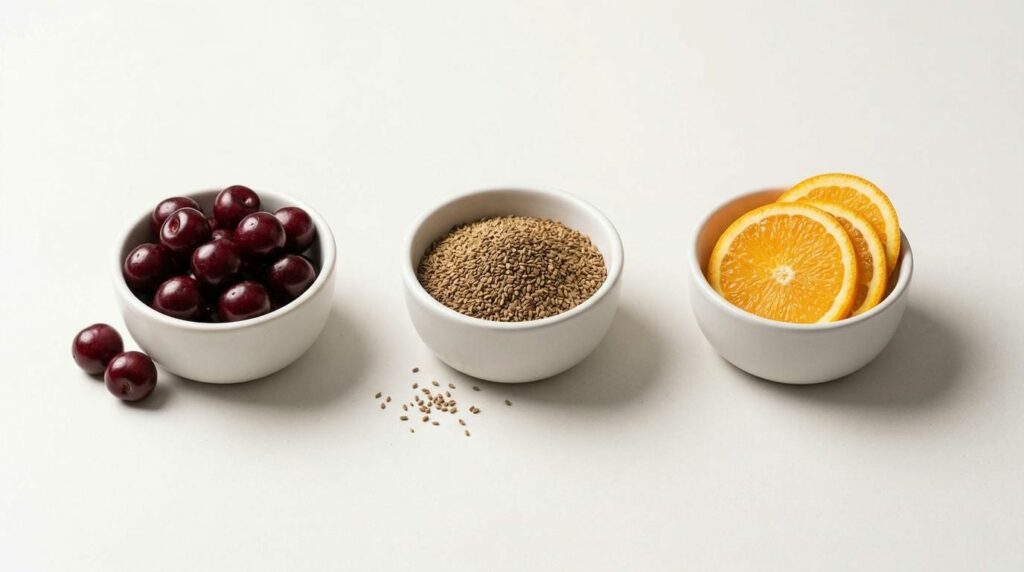
If you’re looking for natural ways to support healthy uric acid levels, you’ve probably come across three names over and over again: tart cherry, celery seed, and vitamin C.
All three have research behind them. All three are available in New Zealand. And all three work differently.
So which one is actually the best?
That’s the question everyone asks. The honest answer might surprise you. First, let’s look at each one properly.
Tart Cherry Extract
What It Does
Tart cherry (Prunus cerasus) contains high concentrations of anthocyanins, powerful antioxidant compounds. These anthocyanins help support healthy uric acid levels through two main mechanisms: they help inhibit the enzymes involved in uric acid production, and they support a healthy inflammatory response.
Strength of Evidence
Strong, and getting stronger.
Multiple clinical studies have shown that tart cherry consumption is associated with lower uric acid levels. A 2012 study found that cherry intake over a two-day period was associated with a 35% lower risk of flare-ups.
More recent research has confirmed that tart cherry extract can meaningfully reduce serum uric acid levels.
This is one of the most studied natural approaches. It’s legitimate science.
Dosage Needed
Most studies use the equivalent of 100-120mg of tart cherry extract (standardised for anthocyanin content) or about 2 tablespoons of tart cherry juice concentrate daily.
Pros
- Strong research support
- Works on both uric acid production and inflammation
- Well-tolerated with very few side effects
- Pleasant taste if using juice form
Cons
- Juice form is high in sugar and calories
- Quality varies significantly between products
- Extract form is more practical but needs proper standardisation
- Takes consistent use to see results (not an overnight fix)
Celery Seed Extract
What It Does
Celery seed (Apium graveolens) contains a compound called 3-n-butylphthalide (3nB) along with other active constituents. It works primarily as a natural diuretic, helping the kidneys excrete more uric acid.
It also has anti-inflammatory properties and may help inhibit xanthine oxidase, the enzyme responsible for uric acid production.
Strength of Evidence
Moderate.
There’s solid traditional use going back centuries, and emerging clinical research supports its effectiveness. A study published in Molecular and Cellular Biochemistry demonstrated that celery seed extract reduced uric acid levels in animal models. Human studies are fewer in number but promising.
The mechanism of action is well understood, even if the clinical trial evidence isn’t as extensive as tart cherry’s.
Dosage Needed
Typical effective doses in studies range from 75-150mg of standardised celery seed extract daily.
Pros
- Supports uric acid excretion (most natural remedies focus on production)
- Anti-inflammatory properties
- Has additional benefits for blood pressure
- Long history of traditional use
Cons
- Fewer human clinical trials than tart cherry
- Can interact with blood-thinning medications
- Not suitable during pregnancy
- Quality and standardisation vary between products
Vitamin C
What It Does
Vitamin C (ascorbic acid) helps lower uric acid levels by improving kidney excretion. It competes with uric acid for reabsorption in the kidneys, meaning more uric acid gets flushed out in your urine.
A straightforward mechanism, and well understood.
Strength of Evidence
Strong.
A large meta-analysis of 13 randomised controlled trials found that vitamin C supplementation significantly reduced serum uric acid levels.
A major prospective study following over 46,000 men found that higher vitamin C intake was associated with a significantly lower risk of elevated uric acid.
The evidence is robust. Vitamin C works. The question is more about how much and whether it’s enough on its own.
Dosage Needed
Most studies showing benefit use 500-1,500mg per day. The sweet spot appears to be around 500mg daily for general support, with higher doses showing incremental benefit.
Pros
- Strong clinical evidence
- Cheap and widely available
- Well-tolerated
- Additional health benefits (immune support, antioxidant)
- Easy to find quality products
Cons
- Works through only one mechanism (excretion)
- Effect size is modest on its own
- High doses can cause digestive upset
- Doesn’t address inflammation directly
Head-to-Head Comparison
| Factor | Tart Cherry | Celery Seed | Vitamin C |
|---|---|---|---|
| Primary mechanism | Reduces production + anti-inflammatory | Increases excretion + anti-inflammatory | Increases excretion |
| Evidence strength | Strong | Moderate | Strong |
| Effect on uric acid production | Yes | Possibly | No |
| Effect on uric acid excretion | Minimal | Yes | Yes |
| Anti-inflammatory | Strong | Moderate | Mild |
| Typical daily dose | 100-120mg extract | 75-150mg extract | 500-1,500mg |
| Side effects | Very rare | Rare (medication interactions) | Digestive upset at high doses |
| Speed of results | 2-4 weeks | 2-4 weeks | 2-4 weeks |
| Cost (standalone) | Moderate | Moderate | Low |
So Which One Wins?
That’s the wrong question.
Look at the table above. Each one works through a different mechanism. Tart cherry primarily reduces uric acid production and fights inflammation. Celery seed primarily boosts excretion and adds anti-inflammatory support. Vitamin C boosts excretion through a different pathway.
They’re complementary, not competing.
The best approach is combining all three.
When you address uric acid from multiple angles, reducing how much your body makes, increasing how much your kidneys clear, and managing the inflammatory response, you get a result that’s significantly better than any single ingredient on its own.
This is why I created URICAH. When I was researching this problem, the obvious conclusion was that no single ingredient was enough on its own.
The smart approach was combining the best-evidenced natural ingredients into one formula. URICAH contains tart cherry extract, celery seed extract, vitamin C, and several other evidence-based ingredients, all dosed according to what the research supports.
You could buy all three separately. Some people do. But you’d need three different bottles, three different dosing schedules, and you’d miss out on the other ingredients that round out a comprehensive approach (like quercetin, bromelain, and turmeric).
What About Other Natural Approaches?
Tart cherry, celery seed, and vitamin C are the big three. They’re not the only players.
Other natural ingredients with research support include:
- Quercetin: Inhibits xanthine oxidase (same enzyme targeted by some prescription medications)
- Bromelain: Proteolytic enzyme with anti-inflammatory properties
- Turmeric/Curcumin: Broad-spectrum anti-inflammatory
A comprehensive approach uses all of these together. Think of it like a team, not a solo act.
The Bottom Line
If you absolutely had to choose just one, tart cherry extract probably has the best combination of strong evidence and multiple mechanisms of action.
You’re limiting yourself unnecessarily by choosing just one.
The research clearly points toward a multi-ingredient approach. Address production, excretion, and inflammation simultaneously. That’s how you give your body the best chance of maintaining healthy uric acid levels long-term.
Stop looking for the single magic bullet. Start thinking about a complete system.
This article is for informational purposes only and does not constitute medical advice. Always consult your healthcare professional before starting any new supplement.
Internal Linking Summary
- Tart Cherry Extract and Uric Acid – Deep dive on tart cherry research
- Celery Seed Extract Benefits – Full breakdown of celery seed evidence
- What to Look for in a Uric Acid Supplement – How to evaluate supplement quality

URICAH! Uric Acid Support
4.85 / 5
read 2,294 customer reviews
$39 NZDTHIS IS YOUR URICAH MOMENT
URICAH provides natural support for healthy uric acid levels.
Our 14 potent, natural ingredients support the body’s normal uric acid levels, supporting joint mobility and function.
URICAH!™ features powerful ingredients used over many years to support healthy uric acid levels such as Tart Cherry, Celery Seed and Chanca Piedra.
LEARN MORE