
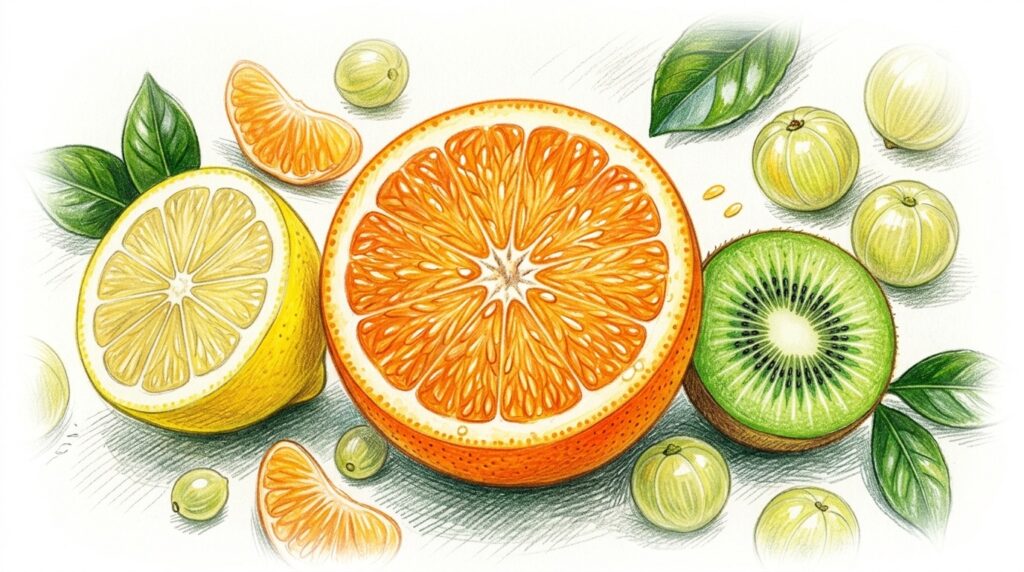
Vitamin C is one of the most studied nutrients on the planet. And when it comes to uric acid, the evidence is surprisingly clear.
Multiple meta-analyses have confirmed that vitamin C supplementation lowers serum uric acid levels. Not dramatically, but consistently and measurably.
Here’s what you need to know, what it can do, what it can’t, and how to use it properly.
How Vitamin C Lowers Uric Acid
Vitamin C works on uric acid primarily through one mechanism: it increases kidney excretion.
Your kidneys are responsible for clearing roughly 70% of the uric acid your body produces. Vitamin C competes with uric acid for reabsorption in the renal tubules.
When there’s more vitamin C present, more uric acid gets flushed out instead of being reabsorbed back into your bloodstream.
This is called a uricosuric effect. It’s the same basic mechanism that some prescription medications use, though vitamin C is gentler and less potent.
There’s also some evidence that vitamin C may have a mild effect on reducing uric acid production, but the excretion pathway is where the real action is.
What the Meta-Analyses Say
This is where vitamin C stands out from many natural remedies. There’s genuine, high-quality evidence.
Meta-analysis #1 (2011, Arthritis Care & Research):
Pooled data from 13 randomised controlled trials with 556 participants. Found that vitamin C supplementation significantly reduced serum uric acid by an average of -0.35 mg/dL.
Meta-analysis #2 (2021, Complementary Therapies in Medicine):
Updated analysis including 16 randomised controlled trials with 1,013 participants. Confirmed a significant reduction in serum uric acid with vitamin C supplementation.
Prospective study (Archives of Internal Medicine):
Followed 46,994 men over 20 years. Found that men taking 1,000-1,499mg of vitamin C daily had a 34% lower risk of elevated uric acid compared to those taking less than 250mg.
The evidence is consistent. Vitamin C lowers uric acid. Not by a huge amount, but reliably.
How Much Do You Need?
The research points to a clear dose range:
- 500mg daily is the dose that showed significant results in the largest randomised controlled trial
- 1,000-1,500mg daily showed even greater benefit in the long-term prospective study
- Below 500mg may not be enough to produce a meaningful uricosuric effect
The Mayo Clinic suggests discussing a 500mg vitamin C supplement with your healthcare provider as a starting point for uric acid support.
Important:
More is not always better. Very high doses (over 2,000mg daily) can cause digestive issues and may increase the risk of kidney stones in some people. Stay in the 500-1,500mg range unless your doctor advises otherwise.
Food Sources vs Supplements
You can get vitamin C from food, of course. The question is whether you can get enough to make a difference for uric acid.
High vitamin C foods:
- Kiwifruit: 85mg per fruit
- Capsicums (red): 190mg per capsicum
- Broccoli: 89mg per cup
- Strawberries: 85mg per cup
- Oranges: 70mg per fruit
- Amla (Indian gooseberry): 600-700mg per 100g
To hit 500mg from food alone, you’d need to eat a serious amount of fruit and vegetables daily. Most people don’t get there consistently.
A supplement fills the gap. 500mg of vitamin C in a capsule is cheap, widely available, and well absorbed.
A note on amla:
Amla fruit (Indian gooseberry) is one of the richest natural sources of vitamin C on earth. It’s also been used in Ayurvedic medicine for centuries for kidney and metabolic support. URICAH includes amla fruit as one of its 14 ingredients, providing a natural source of vitamin C alongside other targeted compounds.
Why Vitamin C Alone Isn’t Enough
Here’s where I need to be straight with you.
A -0.35 mg/dL reduction in uric acid is real, but it’s modest. If your levels are significantly elevated, vitamin C on its own isn’t going to bring them into a healthy range.
Vitamin C works on one pathway: kidney excretion. It doesn’t meaningfully inhibit xanthine oxidase (the enzyme that produces uric acid), and it doesn’t address inflammation when uric acid crystals have already formed.
That’s why vitamin C works best as part of a broader strategy:
- Tart cherry extract inhibits xanthine oxidase, reducing production
- Celery seed extract supports kidney excretion through a different mechanism
- Turmeric provides anti-inflammatory support
- Vitamin C boosts excretion through uricosuric action
Each ingredient addresses a different part of the problem. Together, they cover more ground than any one of them alone.
Combining Vitamin C with Other Supplements
If you’re already taking a multi-ingredient uric acid supplement like URICAH, you can still add a separate vitamin C supplement if you want to increase your dose.
Vitamin C doesn’t interfere with the other natural ingredients commonly used for uric acid support. It’s also safe to take alongside prescription medications like allopurinol, though you should always discuss supplement combinations with your doctor.
One practical tip: take vitamin C with food. It’s absorbed better that way, and it’s gentler on your stomach.
The Bottom Line
Vitamin C is one of the few natural supplements with strong, consistent evidence for lowering uric acid. Multiple meta-analyses confirm it works.
Here’s the practical summary:
- Take 500mg daily as a minimum effective dose
- Eat vitamin C-rich foods as well, but don’t rely on diet alone
- Don’t exceed 2,000mg daily without medical guidance
- Don’t expect it to solve the problem alone, it’s one piece of the puzzle
- Combine it with other evidence-based ingredients for a broader approach
Vitamin C is cheap, safe, widely available, and backed by real evidence. There’s no good reason not to include it in your approach.
URICAH includes amla fruit as a natural vitamin C source alongside 13 other clearly labelled ingredients. No proprietary blends, no guessing.
See the full URICAH ingredient list
Try URICAH with a 90-day money-back guarantee
This article is for informational purposes only and is not intended as medical advice. Consult your healthcare provider before making changes to your health routine.

URICAH! Uric Acid Support
4.8 / 5
read 2,448 customer reviews
$39 NZDTHIS IS YOUR URICAH MOMENT
URICAH provides natural support for healthy uric acid levels.
Our 14 potent, natural ingredients support the body’s normal uric acid levels, supporting joint mobility and function.
URICAH!™ features powerful ingredients used over many years to support healthy uric acid levels such as Tart Cherry, Celery Seed and Chanca Piedra.
LEARN MORE