Not every natural supplement for uric acid has strong clinical evidence behind it.
Quercetin does.
Randomised controlled trials show it can reduce serum uric acid by up to 26.5% at 500mg daily. That’s a meaningful number, and it comes from proper clinical research, not forum posts or anecdotes.
Here’s what quercetin is, how it works, why it’s so effective, and how to use it properly.
What Is Quercetin?
Quercetin is a flavonoid, a type of plant compound found naturally in many common foods.
You’ve been eating it your whole life.
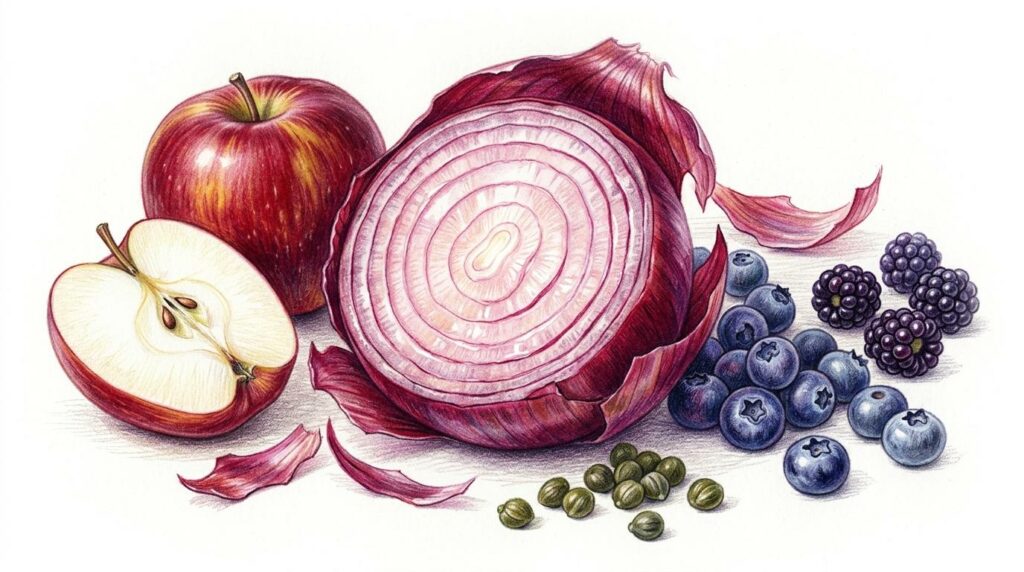
Onions, apples, berries, green tea, broccoli, and red grapes all contain quercetin. It’s one of the most abundant flavonoids in the human diet, and it’s been studied extensively for its antioxidant and anti-inflammatory properties.
But the amounts you get from food are relatively small. Supplemental doses are where the uric acid research gets interesting.
The Clinical Evidence
This is where quercetin stands apart from most natural approaches to uric acid.
Randomised controlled trials (RCTs) have tested quercetin directly for uric acid reduction. These are the gold standard of clinical evidence.
A 2022 meta-analysis published in PMC analysed the available RCTs and found that quercetin supplementation at 500mg daily significantly reduced serum uric acid levels. The average reduction was 26.5%.
To put that in context, if your uric acid is sitting at 0.48 mmol/L (the upper threshold for most labs), a 26.5% reduction would bring it down to approximately 0.35 mmol/L. That’s well within the target range.
That’s a clinically meaningful change from a single natural compound.
The studies used supplemental quercetin, not dietary intake. You’d need to eat an impractical amount of onions and apples to reach 500mg daily from food alone.
The effect was consistent across the studies analysed. This wasn’t a single outlier result. Multiple trials pointed in the same direction.
How Quercetin Works: Xanthine Oxidase Inhibition
Here’s why quercetin is so effective, and why it’s particularly relevant if you’ve ever considered or used allopurinol.
Quercetin inhibits xanthine oxidase.
Xanthine oxidase is the enzyme your body uses to convert purines into uric acid. It’s the final step in uric acid production. Block this enzyme, and you produce less uric acid.
This is the exact same mechanism that allopurinol uses. Allopurinol is the most commonly prescribed medication for high uric acid. It works because it’s a xanthine oxidase inhibitor.
Quercetin targets the same enzyme, naturally.
The strength of inhibition is different. Allopurinol is a more potent xanthine oxidase inhibitor than quercetin. Nobody is claiming quercetin replaces prescription medication.
But for people looking for natural ways to support uric acid levels, having a compound that works through the same proven mechanism as the leading medication is significant.
Beyond Xanthine Oxidase: The Anti-Inflammatory Effect
Quercetin doesn’t stop at reducing uric acid production. It also addresses what happens when uric acid causes problems.
NF-kB inhibition.
Quercetin inhibits NF-kB, one of the primary inflammatory signalling pathways involved in the body’s response to uric acid crystals. This helps modulate the inflammatory cascade that causes pain and swelling.
COX-2 suppression.
It also helps suppress COX-2, another inflammatory pathway. Many anti-inflammatory medications target COX-2, and quercetin provides similar (though milder) support naturally.
Antioxidant activity.
Quercetin is a powerful antioxidant. It neutralises free radicals and reduces oxidative stress. Chronic oxidative stress is both a cause and consequence of elevated uric acid levels.
This dual action, reducing uric acid production while also addressing the inflammatory response, makes quercetin particularly valuable. Most natural compounds do one or the other. Quercetin does both.
The Right Dose
The clinical trials used 500mg daily. That’s your target.
500mg per day is the dose consistently shown to reduce serum uric acid in RCTs.
Some studies have used higher doses (up to 1,000mg), but 500mg appears to be the effective threshold. Going higher doesn’t necessarily provide proportionally better results.
Take it with food. Quercetin absorption improves when taken with dietary fat. A meal containing healthy fats (avocado, olive oil, nuts) enhances bioavailability.
Take it with bromelain.
This is an important practical tip. Quercetin absorption on its own is relatively poor. Bromelain, an enzyme from pineapple, significantly improves quercetin absorption and bioavailability. Many quality quercetin supplements include bromelain for this reason.
URICAH contains both quercetin and bromelain, which is by design, not coincidence. The two work synergistically.
Consistency matters. Like most natural compounds, quercetin needs to be taken consistently to maintain its effect. It’s not a rescue remedy. It’s part of a daily support strategy.
Quercetin in Food
While supplementation is necessary for clinical doses, increasing dietary quercetin is still worthwhile.
Highest food sources:
- Red onions (especially the outer layers)
- Capers (one of the richest sources per gram)
- Apples (with skin on)
- Berries (especially cranberries and lingonberries)
- Green tea
- Broccoli
- Red grapes
- Kale
None of these are high-purine foods. They all fit comfortably into a uric acid-friendly diet and provide additional antioxidants, fibre, and other beneficial compounds.
Cooking reduces quercetin content, so raw or lightly cooked preparations retain more.
What to Look for in a Quercetin Supplement
Not all quercetin supplements are equal.
Form matters.
Quercetin dihydrate is the most common supplemental form and the one used in most clinical trials. Quercetin phytosome is a newer form with improved absorption but less clinical data specifically for uric acid.
Check the dose.
Some supplements contain 100-250mg of quercetin, which is below the clinically tested dose. You want 500mg daily.
Look for bromelain.
As mentioned, bromelain substantially improves quercetin absorption. A supplement that combines the two is more effective than quercetin alone.
Avoid proprietary blends.
You need to know exactly how much quercetin you’re getting. If the label says “proprietary blend” and lists quercetin among several ingredients without individual doses, you have no idea if you’re getting an effective amount. Read more about what to look for in a supplement.
No unnecessary fillers.
Artificial colours, flavours, and excessive excipients don’t add value. Keep it clean and simple.
How Quercetin Fits Into a Complete Approach
Quercetin is impressive on its own. But uric acid management works best with a multi-pronged strategy.
Xanthine oxidase inhibition (quercetin, tart cherry extract) reduces production.
Kidney excretion support (vitamin C, celery seed extract, chanca piedra) increases removal.
Anti-inflammatory support (bromelain, turmeric, quercetin itself) manages the inflammatory response.
Addressing all three simultaneously is more effective than relying on any single ingredient.
That’s exactly the approach I took with URICAH. Fourteen natural ingredients at transparent dosages. Quercetin, bromelain, tart cherry extract, celery seed extract, vitamin C, turmeric, chanca piedra, green coffee bean extract, and more. Each ingredient chosen based on published research. No proprietary blends.
Over 2,200 customer reviews. A 90-day money-back guarantee. Free overnight shipping anywhere in New Zealand.
The Bottom Line
Quercetin has what most natural uric acid supplements lack: proper clinical trial evidence.
A 26.5% reduction in serum uric acid at 500mg daily is meaningful. The mechanism, xanthine oxidase inhibition, is proven and is the same target as the leading medication.
Take 500mg daily with food and bromelain for best absorption. Be consistent. Combine it with other evidence-based approaches for the strongest results.
The research on this one is clear. Quercetin works.
See the full URICAH ingredient list
Try URICAH with a 90-day money-back guarantee
This article is for informational purposes only and is not intended as medical advice. Consult your healthcare provider before making changes to your health routine.

URICAH! Uric Acid Support
4.85 / 5
read 2,294 customer reviews
$39 NZDTHIS IS YOUR URICAH MOMENT
URICAH provides natural support for healthy uric acid levels.
Our 14 potent, natural ingredients support the body’s normal uric acid levels, supporting joint mobility and function.
URICAH!™ features powerful ingredients used over many years to support healthy uric acid levels such as Tart Cherry, Celery Seed and Chanca Piedra.
LEARN MORE