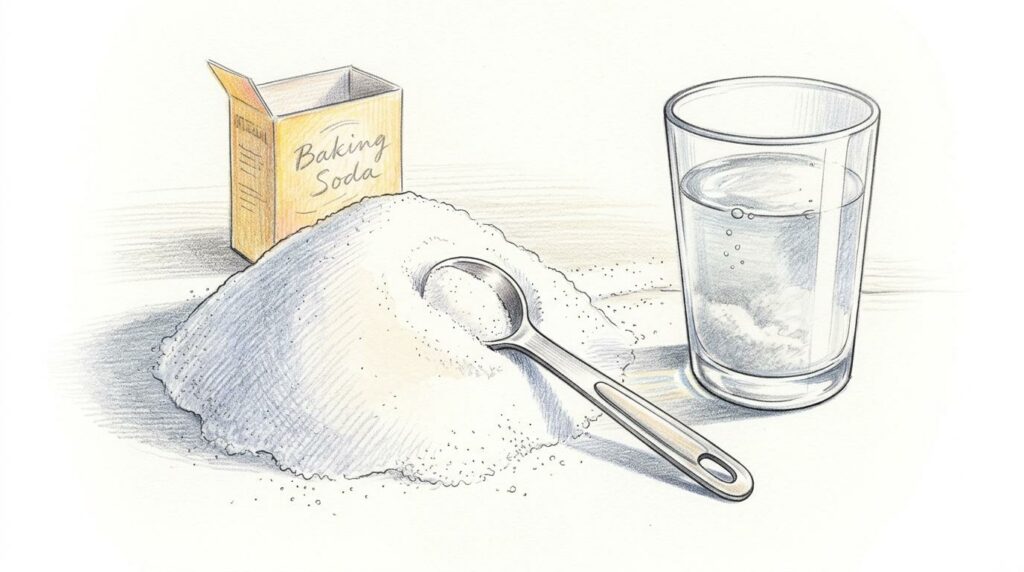
Baking soda for uric acid is one of those home remedies that sounds like it should work.
The logic is simple. Alkalise the body, help the kidneys flush more uric acid, feel better.
It gets recommended constantly on forums and social media. Half a teaspoon in a glass of water, twice a day. Problem solved.
Except it’s not that straightforward. And the risks are more serious than most people realise.
I’m going to walk you through exactly what the research says, what the real dangers are, and what works better.
The Theory: Alkalising Urine to Excrete More Uric Acid
Here’s the idea behind using baking soda (also called bicarbonate of soda or sodium bicarbonate) for uric acid.
Uric acid is more soluble in alkaline urine. When your urine pH rises, your kidneys can excrete uric acid more efficiently. Less accumulation in the blood. Fewer problems.
Sodium bicarbonate is alkaline. Dissolve it in water, drink it, and your urine pH goes up.
This is actually true. Sodium bicarbonate does raise urine pH. That part of the theory holds up.
But here’s where it falls apart.
What the Research Actually Shows
There are no quality clinical trials testing baking soda as a uric acid treatment. Not a single randomised controlled trial has been published showing that oral sodium bicarbonate reduces serum uric acid levels.
Let that sit for a moment.
This is one of the most widely shared home remedies for uric acid, and nobody has proven it works in a proper study.
Urine pH and serum uric acid are different things.
Yes, alkalising your urine can increase the rate at which uric acid leaves through your kidneys. But your body produces uric acid constantly through purine metabolism. Slightly increasing excretion doesn’t necessarily translate to a meaningful drop in blood levels.
Your uric acid levels are determined by the balance between production and excretion. Baking soda only touches one side of that equation, and it touches it weakly.
Medical use is very specific.
Doctors do sometimes use sodium bicarbonate for urinary alkalisation. But this is in clinical settings, with careful monitoring of blood pH, electrolytes, and kidney function. It’s used to prevent kidney stones in specific situations, not as a general uric acid strategy.
The dosing, monitoring, and context are nothing like “half a teaspoon in water before bed.”
The Risks Nobody Mentions
This is the part that concerns me most. People share baking soda recipes online as though they’re sharing a smoothie recipe. The risks are real.
Metabolic alkalosis.
Your blood pH is tightly regulated between 7.35 and 7.45. Regularly consuming sodium bicarbonate can push it too high. Case reports published in PMC (2022) document metabolic alkalosis from chronic baking soda use. Symptoms include muscle twitching, hand tremors, nausea, and in severe cases, cardiac arrhythmias.
This isn’t theoretical. People have been hospitalised for this.
Sodium overload.
Half a teaspoon of baking soda contains roughly 630mg of sodium. If you’re doing this twice daily, that’s 1,260mg of sodium added to your diet from baking soda alone. The recommended daily limit for most adults is 2,300mg.
This matters because high uric acid and high blood pressure frequently go together. Adding over a gram of sodium daily is the last thing you want to do if you’re already dealing with hypertension.
Medication interactions.
Sodium bicarbonate can interfere with how your body absorbs and processes medications. This includes common medications like aspirin, certain antibiotics, lithium, and blood pressure medications. If you’re on any prescription medication, taking baking soda without talking to your doctor is genuinely risky.
Digestive disruption.
Baking soda neutralises stomach acid. Doing this regularly can impair digestion, reduce nutrient absorption, and cause bloating, gas, and stomach discomfort. Your stomach acid exists for a reason.
Kidney strain.
If your kidney function is already compromised, which is common with chronically elevated uric acid, adding sodium bicarbonate can make things worse. Your kidneys have to process the extra sodium and regulate the pH shift. That’s additional work for organs that may already be under pressure.
Why It Stays Popular
I understand the appeal.
Baking soda costs almost nothing. It’s in your kitchen cupboard right now. And the theory sounds reasonable.
But sounding reasonable and being safe and effective are different things.
The placebo effect is powerful. When you take action, any action, you often feel better. That doesn’t mean the baking soda did the work.
Anecdotes spread faster than evidence. One person posts that it helped them, and thousands try it. Nobody follows up to see if it actually lowered their serum uric acid. Nobody tracks the side effects.
Desperation drives experimentation. When you’re dealing with uric acid problems, especially painful flare-ups, you’ll try anything. I get that completely. But trying anything should still mean trying something safe.
The ACV Comparison
Baking soda follows the same pattern as apple cider vinegar.
Popular online. Sounds logical. Zero quality clinical evidence. The internet is full of remedies like this.
The difference is that ACV is relatively harmless for most people. Baking soda carries real medical risks, especially with regular use.
If I had to choose between the two, ACV is safer. But neither has evidence for lowering serum uric acid.
What Actually Works
You want a natural approach. I respect that. But natural doesn’t have to mean unresearched.
Here’s what the evidence supports:
Multiple clinical studies showing it inhibits xanthine oxidase, the enzyme that produces uric acid. This directly reduces production, not just excretion.
Meta-analyses of randomised controlled trials show 500mg daily supports uric acid excretion through the kidneys. Actual evidence. Actual trials.
Supports kidney function, has anti-inflammatory properties, and contains compounds that may inhibit xanthine oxidase. Backed by research, used for centuries.
Proper hydration
Water helps your kidneys flush uric acid. It’s the simplest, cheapest, most evidence-based thing you can do. If you’re going to dissolve something in water and drink it, the water itself is doing more than the baking soda.
These approaches actually target the mechanisms that matter. Production and excretion, addressed safely.
A Multi-Ingredient Approach Makes More Sense
Uric acid management isn’t a single-ingredient problem.
You need to address production, excretion, and the inflammatory response. No single ingredient does all three.
That’s why I created URICAH with 14 natural ingredients at transparent dosages. Tart cherry extract, celery seed extract, vitamin C, bromelain, turmeric, chanca piedra, green coffee bean extract, and more. Each ingredient selected based on published research. No proprietary blends hiding what’s actually in the capsule.
Over 2,200 customer reviews and a 90-day money-back guarantee. Free overnight shipping anywhere in New Zealand.
The full approach to natural uric acid support covers everything from supplementation to hydration to lifestyle changes.
The Bottom Line
Baking soda raises urine pH. That much is true.
But there are no clinical trials proving it lowers serum uric acid levels. And the risks, metabolic alkalosis, sodium overload, medication interactions, kidney strain, are serious enough that this isn’t worth experimenting with.
Bicarbonate of soda is a baking ingredient, not a uric acid strategy.
Put your effort and trust into approaches that have been properly studied, properly dosed, and proven safe for long-term use.
Your body deserves better than kitchen cupboard guesswork.
See the full URICAH ingredient list
Try URICAH with a 90-day money-back guarantee
This article is for informational purposes only and is not intended as medical advice. Consult your healthcare provider before making changes to your health routine.

URICAH! Uric Acid Support
4.85 / 5
read 2,294 customer reviews
$39 NZDTHIS IS YOUR URICAH MOMENT
URICAH provides natural support for healthy uric acid levels.
Our 14 potent, natural ingredients support the body’s normal uric acid levels, supporting joint mobility and function.
URICAH!™ features powerful ingredients used over many years to support healthy uric acid levels such as Tart Cherry, Celery Seed and Chanca Piedra.
LEARN MORE