
You started keto or intermittent fasting for weight loss, metabolic health, or general wellbeing. Then your uric acid levels spiked and you’re wondering if you’ve made things worse.
You’re not imagining it. Keto and fasting genuinely do raise uric acid levels, at least in the short term.
But the full picture is more nuanced than “keto is bad for uric acid,” and understanding the mechanism helps you make smarter decisions.
Why Keto Raises Uric Acid
The mechanism is specific and well-documented.
When your body enters ketosis, it produces ketone bodies, primarily beta-hydroxybutyrate. These ketones need to be excreted through your kidneys.
The problem is that ketones and uric acid compete for the same transport pathways in your kidneys.
Think of it like a two-lane road that suddenly has double the traffic. Your kidneys have uric acid transporters called URAT1 that normally handle uric acid excretion. When ketone bodies show up, they compete for binding sites on those same transporters.
The result: less uric acid gets flushed out, and your levels rise.
This isn’t a side effect of eating too much meat on keto. It’s a direct metabolic consequence of ketosis itself. Even if you ate a perfectly clean ketogenic diet with moderate protein, the ketones alone would reduce uric acid excretion.
The Fasting Effect
Fasting creates the same problem, sometimes more aggressively.
When you fast, your body enters ketosis faster and more deeply than it typically does on a standard ketogenic diet. The longer the fast, the more ketones your body produces, and the more those ketones compete with uric acid for kidney excretion.
Research published in Metabolism found that fasting-induced ketosis significantly inhibits renal excretion of uric acid. The magnitude of changes in ketone body levels directly correlated with the reduction in uric acid clearance.
This applies to intermittent fasting too, though the effect is less dramatic because the fasting windows are shorter. A 16:8 protocol will produce a milder version of this effect compared to a 48-hour water fast.
The key point: any state of ketosis, whether from diet or fasting, temporarily reduces your body’s ability to excrete uric acid.
The Initial Spike vs Long-Term Effect
Here’s where it gets interesting.
The uric acid spike from keto is primarily a short-term phenomenon. Research suggests the increase typically occurs during the first two to eight weeks of ketosis, while your body adapts to burning fat as its primary fuel source.
After that adaptation period, uric acid levels often return to baseline or even drop below where they started. A study cited by Virta Health found that after the initial keto-adaptation phase, uric acid levels stabilised in most participants.
Why? A few possible reasons:
- Your kidneys adapt to handling ketone bodies more efficiently
- Weight loss from the diet reduces uric acid production (body fat is associated with higher uric acid levels)
- Reduced sugar and fructose intake lowers uric acid production
- Improved insulin sensitivity supports better kidney function
So the trajectory often looks like this: levels go up for a few weeks, then come back down.
The problem is that those few weeks can be rough if your levels are already elevated.
The Real Risk: Going In and Out of Ketosis
This is the practical point most articles miss.
The biggest risk isn’t sustained ketosis. It’s repeatedly entering and exiting ketosis. Every time you go back into ketosis, you trigger another spike in uric acid. Every time you drop out and go back in, you’re hitting your body with that initial surge again.
If you’re doing keto Monday to Friday and then eating carbs on weekends, you’re potentially triggering a mini uric acid spike every Monday. If you’re fasting inconsistently, same problem.
Consistency matters. If you’re going to do keto or fasting, commit to it steadily rather than bouncing in and out.
What About Purines on Keto?
There’s a secondary concern beyond the ketone competition.
Many people on keto eat significantly more red meat and seafood, both of which are high in purines. If your keto diet is heavy on steak, organ meats, and shellfish, you’re adding purine-driven uric acid production on top of the ketone-driven excretion problem.
This doesn’t mean you can’t eat these foods on keto. But if you’re managing uric acid, be strategic:
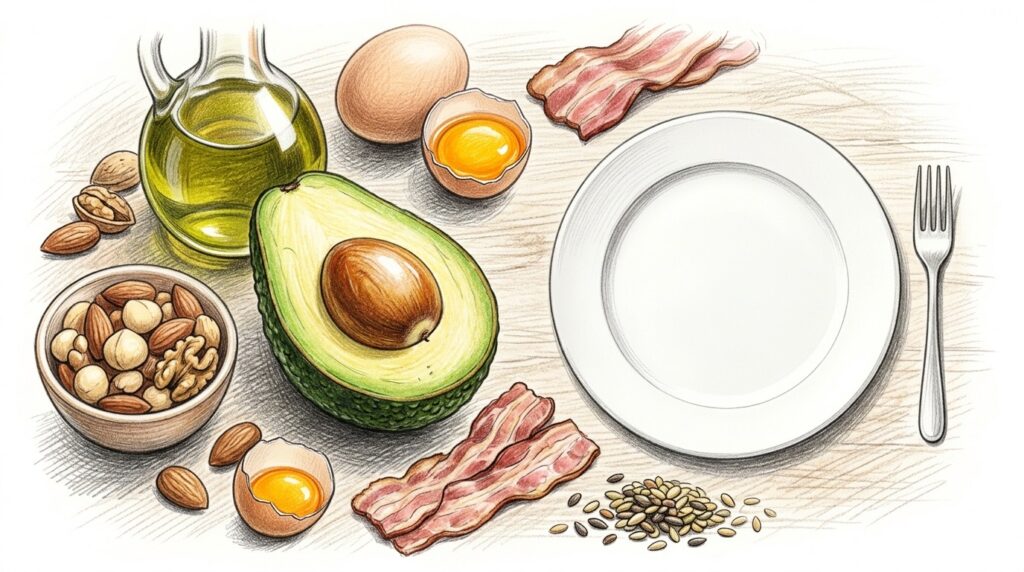
- Focus on moderate-purine protein sources like eggs, chicken, and dairy
- Include plenty of low-purine fats: avocado, olive oil, nuts
- Don’t default to steak and bacon for every meal
- Include vegetables generously, they’re low-carb and low-purine
Practical Advice for Managing Both
If you want to do keto or intermittent fasting while managing uric acid levels, here’s how to reduce the risk.
During the Adaptation Phase (First 6-8 Weeks)
Hydrate aggressively.
This is non-negotiable. Your kidneys are already struggling to excrete uric acid because of ketone competition. Give them as much water as possible to work with. Aim for 3+ litres per day during the first two months.
Keto already has a diuretic effect (you lose water when glycogen stores deplete), so you need more water than you think.
Monitor your levels.
If you can, get a baseline uric acid blood test before starting keto, then check again at four and eight weeks. This gives you real data instead of guessing.
Start gradually.
Rather than jumping straight into strict keto or extended fasts, ease in. Start with a moderate low-carb approach, then gradually reduce carbs.
This produces a gentler ketone increase and a less dramatic uric acid spike.
Keep your supplement routine consistent.
If you’re taking anything for uric acid support, don’t skip it during this phase. Your body needs the extra support.
For Ongoing Keto or IF
Stay consistent.
Don’t yo-yo in and out of ketosis. Pick your approach and stick with it. Consistency lets your body adapt and stabilises uric acid levels.
Choose your proteins wisely.
Moderate-purine proteins over high-purine ones. You can still eat well on keto without loading up on organ meats and shellfish every day.
Don’t combine fasting with high-purine feasting.
A common mistake: fasting all day, then breaking the fast with a huge high-purine meal. That’s hitting your body with the fasting-induced spike and a purine load simultaneously.
Break your fast with moderate-purine foods and spread your protein intake across your eating window.
Electrolytes matter.
Keto depletes electrolytes. Low potassium and magnesium can affect kidney function. Supplement or eat potassium-rich, keto-friendly foods like avocado and spinach.
Supporting Your Body on Keto
URICAH contains 14 natural ingredients that support healthy uric acid levels and kidney function. If you’re doing keto or fasting, consistent supplementation helps support your kidneys during the adaptation period when ketones are competing with uric acid for excretion.
No proprietary blends. Every dosage on the label. 90-day money-back guarantee. 2,200+ customer reviews. Free overnight shipping in NZ when you order by 3pm on weekdays.
Read about natural ways to support healthy uric acid levels
Learn about foods that help lower uric acid
The Bottom Line
Keto and fasting raise uric acid in the short term because ketone bodies compete with uric acid for kidney excretion. This effect is real, measurable, and typically lasts two to eight weeks.
After the adaptation phase, levels usually stabilise or improve. The biggest risk isn’t sustained ketosis; it’s bouncing in and out repeatedly.
If you’re managing uric acid levels and want to try keto or fasting, hydrate aggressively, ease in gradually, choose moderate-purine proteins, stay consistent, and monitor your levels. It’s entirely manageable with the right approach.
This article is for informational purposes only and is not intended as medical advice. Consult your healthcare provider before making changes to your health routine.

URICAH! Uric Acid Support
4.85 / 5
read 2,294 customer reviews
$39 NZDTHIS IS YOUR URICAH MOMENT
URICAH provides natural support for healthy uric acid levels.
Our 14 potent, natural ingredients support the body’s normal uric acid levels, supporting joint mobility and function.
URICAH!™ features powerful ingredients used over many years to support healthy uric acid levels such as Tart Cherry, Celery Seed and Chanca Piedra.
LEARN MORE