
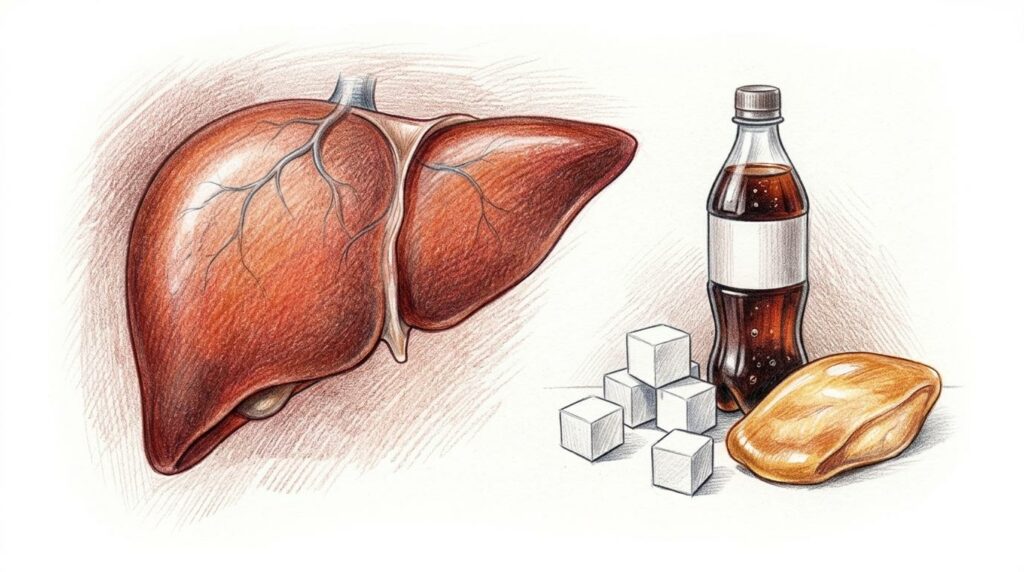
Roughly 60% of people with elevated uric acid also have fatty liver disease.
Compare that to 29% in the general population.
That is more than double the rate. And it points to a deep metabolic connection that most people are completely unaware of.
Fatty liver disease and elevated uric acid share the same root causes. They develop through the same pathways. And they make each other worse in ways that are only now becoming fully understood.
When I created URICAH, one of the things that stood out from the research was how many conditions cluster around elevated uric acid. Heart disease. Diabetes. Kidney problems. And fatty liver is right there in the mix, tied to the same metabolic dysfunction.
What is fatty liver disease?
Non-alcoholic fatty liver disease (NAFLD) is the accumulation of excess fat in your liver cells, in people who drink little or no alcohol.
It is the most common liver condition in the developed world. An estimated 25% of the global population has it.
In its early stages, fatty liver causes no symptoms. Most people discover it incidentally through blood tests or imaging done for other reasons.
But it is not harmless. Fatty liver can progress to non-alcoholic steatohepatitis (NASH), where the liver becomes inflamed and scarred. In severe cases, it can lead to cirrhosis and liver failure.
In New Zealand, fatty liver disease rates are climbing in parallel with obesity and metabolic syndrome. It is becoming a serious public health concern.
How uric acid and fatty liver are connected
The relationship between these two conditions is not just statistical. There are concrete biological mechanisms linking them.
Shared root cause: insulin resistance
Insulin resistance is the common ground where fatty liver and elevated uric acid meet.
When your cells become resistant to insulin, your pancreas produces more of it to compensate. This excess insulin has two relevant effects.
First, it tells your kidneys to reabsorb more uric acid rather than excreting it. Your uric acid levels rise, not because you are producing more, but because your body is keeping more of what it produces.
Second, insulin resistance promotes fat accumulation in the liver. When cells cannot respond to insulin properly, the liver converts excess glucose into fat and stores it in its own tissue.
Same metabolic dysfunction. Two different manifestations.
We cover insulin resistance and uric acid in detail in our guide on uric acid and diabetes.
The fructose pathway
This is where the story gets particularly interesting.
Fructose is the only sugar that directly increases uric acid production. When your liver metabolises fructose, it uses ATP (cellular energy) at a rapid rate. The breakdown of ATP generates purines, which are converted to uric acid.
But that is only half the picture.
The same fructose metabolism that produces uric acid also drives fat production in the liver. Fructose bypasses the normal regulatory controls on fat synthesis. Your liver converts it directly into fat, a process called de novo lipogenesis.
One substance. Two problems. Fructose is fuelling both elevated uric acid and fatty liver simultaneously through the same metabolic pathway.
This is why reducing fructose intake, particularly from sugary drinks, fruit juices, and processed foods with high-fructose corn syrup, is one of the most effective things you can do for both conditions.
Uric acid directly promotes liver fat accumulation
Here is where it moves beyond shared causes.
Research shows that uric acid itself stimulates fat production in liver cells.
A study published in the Journal of Hepatology found that uric acid activates enzymes involved in fat synthesis within liver cells. It essentially tells the liver to make and store more fat.
This means elevated uric acid is not just correlated with fatty liver. It is actively contributing to it.
Animal studies have shown that lowering uric acid reduces liver fat content, even without other dietary changes. While human studies are ongoing, the mechanism is clear.
The liver processes uric acid
Your liver is where uric acid is produced. The enzyme xanthine oxidase, which catalyses the final step in uric acid production, is highly active in liver tissue.
When your liver is fatty and inflamed, xanthine oxidase activity increases. This means a fatty liver produces more uric acid than a healthy liver.
More uric acid then promotes more liver fat. More liver fat promotes more uric acid. The feedback loop is self-reinforcing.
Oxidative stress and inflammation
Both elevated uric acid and fatty liver generate oxidative stress and chronic low-grade inflammation.
Uric acid produces reactive oxygen species inside cells. Fatty liver generates inflammatory cytokines as immune cells respond to excess fat.
These inflammatory signals compound each other, accelerating damage to the liver and promoting the progression from simple fatty liver to the more dangerous NASH.
Recent research advances
The scientific understanding of this connection is evolving rapidly.
A 2023 study in Clinical Rheumatology confirmed the 60% prevalence figure. Researchers found that people with elevated uric acid had fatty liver at more than double the rate of controls, even after adjusting for BMI, alcohol intake, and other metabolic factors.
Research from Georgia State University published in 2025 identified specific genes involved in both uric acid metabolism and liver fat regulation. This suggests the connection is not just metabolic but also genetic. Some people may be genetically predisposed to both conditions through shared pathways.
A meta-analysis of prospective studies found that for every 1 mg/dL increase in serum uric acid, the risk of developing NAFLD increased by 21%.
Who is at risk?
The overlap between elevated uric acid and fatty liver is strongest in people who also have one or more of the following.
- Central obesity (carrying weight around the midsection)
- Insulin resistance or type 2 diabetes
- High triglycerides
- High blood pressure
- High fructose intake
- Sedentary lifestyle
If you recognise yourself in this list and have elevated uric acid, asking your doctor about a liver function test and ultrasound is worthwhile.
For more on the connections between uric acid and these related conditions, see our guides on uric acid and heart disease and uric acid and high blood pressure.
What you can do
The metabolic overlap between these conditions means many of the same strategies help both.
Reduce fructose intake
This is the single most targeted intervention for the uric acid-fatty liver connection.
Cut sugary drinks. Eliminate fruit juice. Read labels for added sugars and high-fructose corn syrup.
Whole fruit in moderate amounts is fine. The fibre slows fructose absorption and limits the metabolic impact. It is the concentrated, liquid fructose that does the damage.
Manage your weight gradually
Weight loss is one of the most effective interventions for both fatty liver and elevated uric acid.
Losing 5-10% of body weight can significantly reduce liver fat content. It also improves insulin sensitivity, which helps your kidneys excrete more uric acid.
The key word is gradually. Rapid weight loss through crash diets causes massive cellular breakdown, releases purines, and spikes uric acid. It can also worsen liver inflammation in the short term.
Aim for 0.5 to 1 kilogram per week. Our guide on obesity, weight loss, and uric acid covers how to do this safely.
Exercise regularly
Exercise improves insulin sensitivity independently of weight loss.
It also reduces liver fat directly. Studies show that both aerobic exercise and resistance training decrease liver fat content, even without significant changes in body weight.
Aim for at least 150 minutes of moderate activity per week. Walking counts.
Stay hydrated
Adequate hydration supports kidney function and uric acid excretion.
Aim for at least 2 litres of water daily.
See our guide on dehydration and uric acid for more.
Limit alcohol
Alcohol is processed by the liver and contributes to both liver fat accumulation and uric acid production.
Even moderate alcohol consumption can worsen fatty liver. Reducing intake gives your liver a chance to recover.
Consider targeted support
Certain natural compounds may help support both healthy uric acid levels and liver function.
Vitamin C, quercetin, and tart cherry have evidence supporting their role in uric acid management. Our guide on natural ways to support uric acid levels covers the options.
Get tested
If you have elevated uric acid, ask your doctor about screening for fatty liver disease. A liver function blood test and an abdominal ultrasound are the standard first steps.
Similarly, have your uric acid levels checked if you have been diagnosed with fatty liver. Our guide on uric acid levels explained will help you understand your results.
The bigger picture
Fatty liver and elevated uric acid are two expressions of the same metabolic dysfunction.
They share root causes in insulin resistance and fructose metabolism. They make each other worse through direct biological feedback loops. And they travel with the same companions: obesity, diabetes, high blood pressure, and cardiovascular disease.
But the flip side is powerful. Addressing the shared root causes, reducing fructose, managing weight, improving insulin sensitivity through exercise, helps both conditions simultaneously.
You do not need separate strategies. You need one coherent approach that targets the underlying metabolic dysfunction driving everything.
This article is for informational purposes only and is not intended as medical advice. Consult your healthcare provider before making changes to your health routine.

URICAH! Uric Acid Support
4.85 / 5
read 2,294 customer reviews
$39 NZDTHIS IS YOUR URICAH MOMENT
URICAH provides natural support for healthy uric acid levels.
Our 14 potent, natural ingredients support the body’s normal uric acid levels, supporting joint mobility and function.
URICAH!™ features powerful ingredients used over many years to support healthy uric acid levels such as Tart Cherry, Celery Seed and Chanca Piedra.
LEARN MORE