You can’t manage what you don’t measure.
If you want to know where your uric acid levels stand, you need a blood test. A uric acid test in NZ is straightforward and widely available. The good news: getting tested in New Zealand is straightforward, affordable, and widely available.
Here’s everything you need to know about getting tested, understanding your results, and knowing when to retest.
What the Test Is
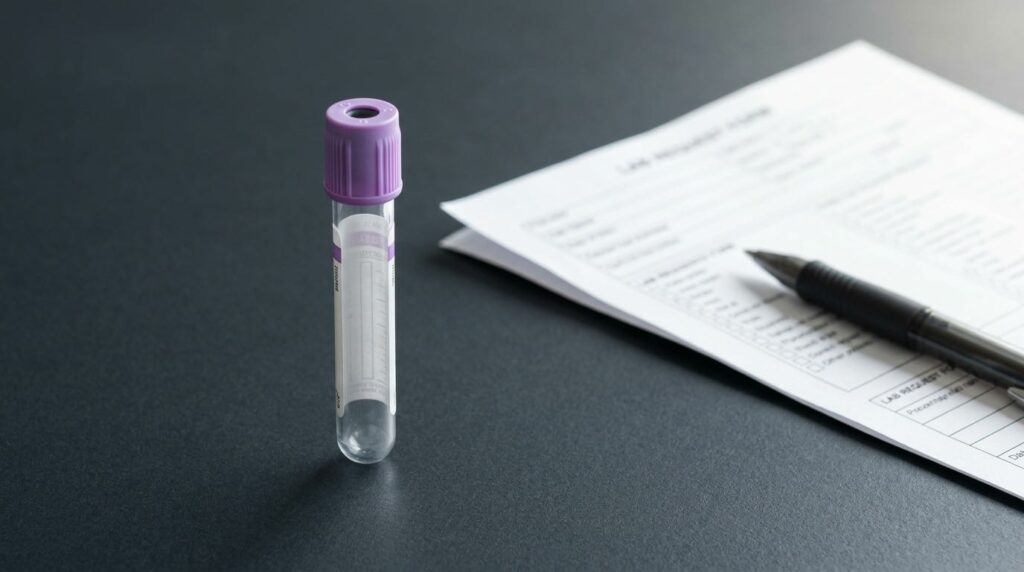
The test you need is called a serum urate test (also called a serum uric acid test). It’s a standard blood test that measures the concentration of uric acid in your blood.
A small sample of blood is drawn from a vein, usually in your arm. The sample is analysed in an accredited laboratory using a method called an uricase assay, which is highly reliable and precise.
It’s quick, routine, and no different from any other blood test you’ve had.
How to Get Tested
You have two main options in New Zealand.
Through your GP
The most common route.
Book an appointment with your GP and ask for a serum urate test. Your doctor can add it to a standard blood panel alongside other checks like cholesterol, blood sugar, and kidney function.
If your GP thinks the test is clinically indicated (and if you have risk factors for elevated uric acid, it usually is), it may be fully or partially funded. There may be a small lab fee depending on your PHO and the lab provider.
Your GP will receive the results and can discuss them with you, including what they mean in the context of your overall health.
Direct through a community lab
If you’re 16 or older, you can request a uric acid test without a GP referral through direct-to-consumer lab services like MyTests (run by Awanui Labs). No appointment with a doctor is needed.
Here’s how it works:
- Order the test online
- Visit any of 150+ collection centres across New Zealand (no booking required at most locations)
- Have your blood drawn
- Receive your results by email, typically within 7 days
Awanui Labs has collection centres throughout Northland, Auckland, Taranaki, Hawke’s Bay, Wellington (including Hutt Valley and Porirua), Nelson/Marlborough, Canterbury, South Canterbury, Dunedin, Otago, and Invercargill. So wherever you are in NZ, there’s likely a centre near you.
Some community pharmacies also offer uric acid testing as a health service. It’s worth checking with your local pharmacy.
NZ Uses mmol/L, Not mg/dL
This is important.
New Zealand measures uric acid in millimoles per litre (mmol/L). Most international research and many online resources use milligrams per decilitre (mg/dL). If you’re reading overseas articles, you’ll need to convert.
The conversion:
mg/dL x 0.0598 = mmol/L
Or roughly:
Divide the mg/dL number by 16.8 to get mmol/L.
For example, 7.0 mg/dL = approximately 0.42 mmol/L.
What Your Results Mean
Normal ranges in NZ
Men (over 10 years):
0.23 – 0.42 mmol/L
Women (over 13 years):
0.16 – 0.42 mmol/L
The target that matters
While the “normal” range goes up to 0.42 mmol/L, the clinical target recommended by New Zealand health authorities for managing uric acid is below 0.36 mmol/L.
Research consistently shows that keeping serum urate below 0.36 mmol/L significantly reduces the risk of uric acid-related health issues. This is the number to aim for.
If your result comes back at, say, 0.39 mmol/L, it might technically fall within the “normal” range, but it’s above the recommended target. That’s the kind of nuance that’s easy to miss if you’re just glancing at your results.
For a more detailed breakdown of what different levels mean, read our guide on uric acid levels explained.
Quick reference
- Below 0.36 mmol/L – Target range. This is where you want to be.
- 0.36 – 0.42 mmol/L – Elevated. Above the recommended target. Time to take action through diet, lifestyle, and potentially supplementation.
- Above 0.42 mmol/L – High. Outside the normal range entirely. Talk to your GP about a management plan.
- Above 0.50 mmol/L – Significantly elevated. Medical intervention may be needed alongside lifestyle changes.
When to Get Tested
If you’ve never been tested
If you have any risk factors for elevated uric acid, get a baseline test.
Risk factors include:
- Family history of elevated uric acid or joint issues
- Being overweight or obese
- Maori or Pacific Island ethnicity (higher genetic predisposition)
- Diet high in red meat, seafood, or sugar
- Regular alcohol consumption, especially beer
- Taking medications that can raise uric acid (diuretics, low-dose aspirin)
- Kidney issues
- Being a woman past menopause
- Age over 40 for men, over 50 for women
If you tick even one or two of those boxes, knowing your number is worth your time.
If you’re actively managing your levels
Once you know your levels are elevated and you’re taking steps to bring them down (diet changes, exercise, supplementation), retesting is how you track progress.
A reasonable schedule:
- Initial retest: 8-12 weeks after making changes. This gives your body time to respond.
- Ongoing monitoring: Every 3-6 months while you’re actively working to lower levels.
- Maintenance: Once you’ve reached your target and maintained it, annual testing is usually sufficient.
Timing matters
A few things to keep in mind about test timing:
- Fasting isn’t strictly required for a uric acid test, but some labs prefer it. Ask when you book.
- Avoid testing during or immediately after a flare-up. Uric acid levels can actually drop temporarily during acute episodes because uric acid is being deposited in tissue rather than circulating in blood. Wait 2-4 weeks after symptoms settle for an accurate reading.
- Stay consistent. Try to test at similar times and conditions so your results are comparable.
What to Do With Your Results
Getting tested is step one. Taking action is step two.
If your levels are above 0.36 mmol/L, start with the fundamentals:
- Clean up your diet: reduce high-purine foods, cut sugar, eat more uric acid-friendly foods
- Stay hydrated
- Exercise regularly
- Maintain a healthy weight
- Consider targeted supplementation
If your levels are significantly elevated (above 0.42 mmol/L), talk to your GP about a comprehensive management plan.
Know Your Number
Too many people in New Zealand are walking around with elevated uric acid and don’t know it.
The test is simple, widely available, and gives you actionable information about your health.
URICAH was created to support healthy uric acid levels with 14 clearly labelled natural ingredients, no proprietary blends, and transparent dosages. If your test shows elevated levels and you want practical support alongside diet and lifestyle changes, URICAH is designed for exactly that.
Over 2,200 customers have reviewed URICAH. Free overnight shipping across New Zealand, order by 3pm weekdays for same-day dispatch. And there’s a 90-day money-back guarantee, so there’s zero risk in giving it a go.
This article is for informational purposes only and is not intended as medical advice. Consult your healthcare provider before making changes to your health routine.

URICAH! Uric Acid Support
4.85 / 5
read 2,294 customer reviews
$39 NZDTHIS IS YOUR URICAH MOMENT
URICAH provides natural support for healthy uric acid levels.
Our 14 potent, natural ingredients support the body’s normal uric acid levels, supporting joint mobility and function.
URICAH!™ features powerful ingredients used over many years to support healthy uric acid levels such as Tart Cherry, Celery Seed and Chanca Piedra.
LEARN MORE