
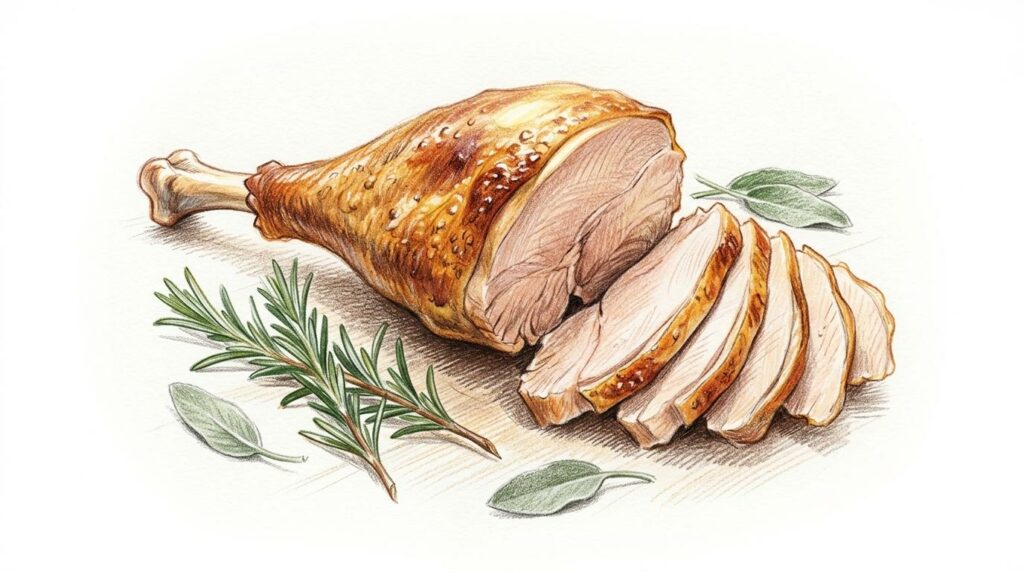
Turkey doesn’t get asked about as often as chicken or red meat. But when Christmas rolls around or someone’s trying to mix up their protein choices, the question lands: is turkey safe for uric acid?
The answer is yes, with some caveats.
Turkey sits in the moderate purine range at roughly 150mg per 100g. That’s comparable to chicken and lower than most red meat cuts. It’s a reasonable protein choice for anyone managing uric acid levels.
But not all turkey is created equal. The cut matters. The preparation matters. And processed turkey products are a different story entirely.
Turkey Purine Content by Cut
Different parts of the turkey have different purine levels. Here’s how they compare.
| Turkey Cut | Purines per 100g | Category |
|---|---|---|
| Turkey breast (skinless) | 130-150mg | Moderate |
| Turkey thigh (skinless) | 150-170mg | Moderate |
| Turkey leg/drumstick | 155-175mg | Moderate-high |
| Turkey mince | 140-165mg | Moderate (varies by fat content) |
| Turkey deli slices | 100-130mg | Moderate (but high sodium) |
| Turkey liver | 300mg+ | Very high |
The pattern is consistent across all poultry: white meat (breast) is lower in purines than dark meat (thigh, leg). The difference isn’t dramatic, but it’s consistent.
Turkey liver follows the same rule as all organ meats. It’s very high in purines and should be avoided if you’re managing uric acid.
How Turkey Compares to Other Meats
Here’s the context that actually helps you make decisions.
| Meat | Purines per 100g | Notes |
|---|---|---|
| Turkey breast | 130-150mg | One of the leaner options |
| Chicken breast | 130-150mg | Very similar to turkey |
| Pork loin | 130-150mg | Comparable when lean |
| Beef sirloin | 110-150mg | Similar range, higher saturated fat |
| Lamb chop | 140-160mg | Moderate, but fattier cuts are higher |
| Venison | 130-160mg | Lean, moderate purines |
Turkey and chicken are almost identical in purine content. Both sit comfortably in the moderate range.
The advantage of both poultry options over red meat is the lower saturated fat content, particularly in breast cuts. Research has consistently shown that red meat carries additional risk factors for elevated uric acid beyond just purines, including higher saturated fat and iron content.
If you’re choosing between turkey, chicken, and red meat for your regular protein rotation, turkey and chicken are the smarter picks.
White Meat vs Dark Meat
This distinction matters more than most people realise.
Turkey breast (white meat)
Lower in purines, lower in fat, higher in protein per gram. This is your best everyday choice. A 150g turkey breast portion gives you roughly 195-225mg of purines, which is well within a sensible daily purine budget.
Turkey thigh and leg (dark meat)
Slightly higher in purines, more fat, more flavour. The purine difference compared to breast is roughly 20-30mg per 100g. Not a dealbreaker, but worth noting if you’re being precise.
Dark meat is fine occasionally. It just shouldn’t be your default if breast is available.
Turkey wings
Similar to dark meat in purine content, with the added issue of skin. Turkey skin is high in fat and adds to the overall purine load. Remove it before eating.
The practical takeaway
Choose breast when you can. Don’t stress about dark meat occasionally. Always remove the skin.
Processed Turkey: A Different Category
Here’s where turkey gets more complicated.
Processed turkey products often have lower purine content per 100g than fresh turkey. That sounds like good news, but it comes with trade-offs.
Turkey deli slices
Lower in purines (~100-130mg per 100g) because they contain fillers, water, and additives. But they’re typically high in sodium, nitrates, and preservatives. The lower purine count doesn’t make them a healthy choice.
Turkey sausages
Same issue. Fillers dilute the purine content but add sodium, fat, and processing chemicals. They’re better than pork sausages for purine content, but that’s a low bar.
Turkey bacon
Heavily processed, high in sodium. The purine content is moderate, but the overall nutritional profile is poor.
My recommendation
Fresh turkey beats processed turkey every time. The slightly higher purine content of fresh turkey is more than offset by the absence of sodium, nitrates, and preservatives that come with processed products.
Christmas and Holiday Turkey
For most New Zealanders, the biggest turkey meal of the year is Christmas dinner.
Here’s how to handle it.
A standard Christmas serving of roast turkey is roughly 150-200g. That gives you approximately 200-300mg of purines from the turkey alone. Add in the rest of the meal (roast vegetables are fine, gravy adds some, stuffing varies) and you’re looking at a moderately high-purine meal.
Practical Christmas strategies:
- Choose breast meat over dark meat and leg
- Remove the skin before eating
- Skip the turkey liver pate if it’s on the table
- Go easy on the gravy (meat-based gravies concentrate purines from the drippings)
- Load up on roasted vegetables as your main sides
- Stay well hydrated throughout the day
- Don’t combine the turkey with other high-purine proteins
One high-purine meal at Christmas isn’t going to derail your uric acid management. It’s the pattern that matters, not the single event.
How Much Turkey Is Safe?
For regular consumption (not just holidays), here are practical guidelines.
Serving size
A sensible portion is 120-150g of cooked turkey per meal. That’s roughly the size of your palm and the thickness of a deck of cards.
Frequency
Turkey can be part of your regular protein rotation two to three times a week, similar to chicken. It doesn’t need to be treated with extra caution compared to chicken.
What to pair it with
- Salads and vegetables (low purine, high nutrient)
- Rice, pasta, or bread (low purine)
- Beans and lentils (plant purines, research shows minimal uric acid impact)
When to reduce turkey intake
- During a uric acid flare (reduce all animal protein)
- If your levels are consistently elevated and you’re actively lowering them
- If you’re already eating other moderate-to-high purine proteins daily
Turkey Mince as a Red Meat Substitute
One of the best practical uses for turkey is as a substitute for beef mince.
Turkey mince has a similar purine content to beef mince but significantly less saturated fat (especially if you buy lean turkey mince). You can use it in bolognese, tacos, meatballs, burgers, and stir-fries.
The swap won’t reduce your purine intake much, but it removes the additional risk factors associated with red meat consumption.
I use turkey mince in my own kitchen regularly. It works in any recipe that calls for beef mince, with minimal difference in taste or texture.
The Bottom Line
Turkey is a moderate-purine protein that’s perfectly safe for most people managing uric acid levels.
Choose breast over dark meat when you can. Avoid processed turkey products despite their lower purine numbers. Remove the skin. Keep portions to 120-150g per serve.
It’s comparable to chicken in every meaningful way and a better choice than red meat for regular consumption.
Use it as part of a varied protein rotation alongside chicken, fish, eggs, and plant-based proteins. That’s the approach that works long term.
This article is for informational purposes only and is not intended as medical advice. Consult your healthcare provider before making changes to your health routine.

URICAH! Uric Acid Support
4.85 / 5
read 2,294 customer reviews
$39 NZDTHIS IS YOUR URICAH MOMENT
URICAH provides natural support for healthy uric acid levels.
Our 14 potent, natural ingredients support the body’s normal uric acid levels, supporting joint mobility and function.
URICAH!™ features powerful ingredients used over many years to support healthy uric acid levels such as Tart Cherry, Celery Seed and Chanca Piedra.
LEARN MORE