
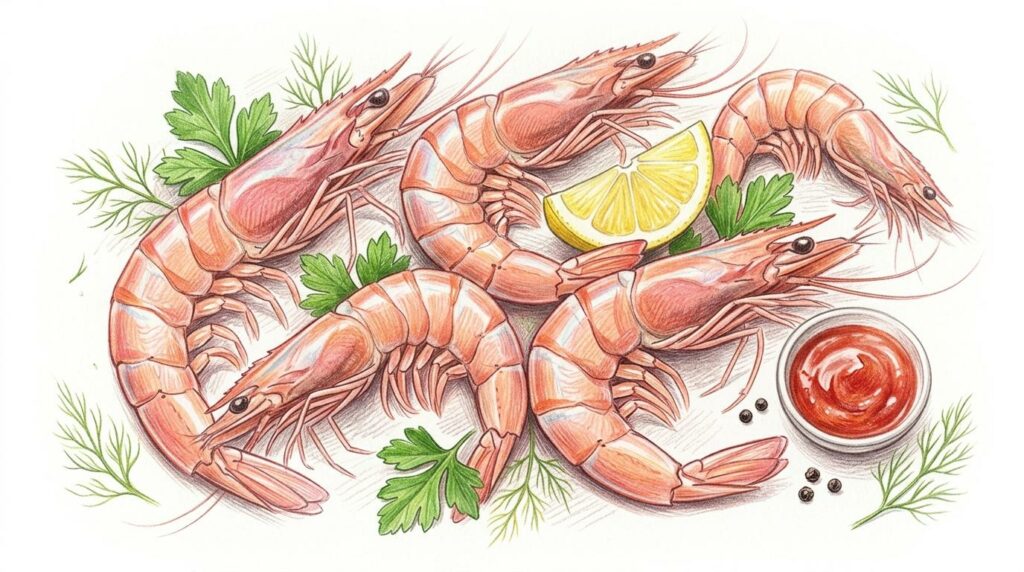
Prawns are one of New Zealand’s most popular seafood choices. They show up at summer barbecues, in stir-fries, and piled high on platters at every holiday gathering.
So where do they sit on the purine scale?
The short answer: moderate. Prawns contain roughly 150mg of purines per 100g, which puts them well below high-purine offenders like mussels and anchovies, but higher than most white fish.
That means you don’t need to cut them out entirely. You just need to be smart about how much you eat and how often.
Prawn Purine Content: The Numbers
Here’s how different types of prawns stack up. The purine content doesn’t vary dramatically between varieties, but there are small differences worth knowing.
| Prawn Type | Purines per 100g |
|---|---|
| King prawns | 140-160mg |
| Tiger prawns | 145-155mg |
| Cocktail prawns (cooked, peeled) | 130-150mg |
| Prawn heads and shells | Higher concentration |
All varieties fall into the moderate purine category. That’s the 100-200mg per 100g range that nutrition researchers classify as requiring portion awareness rather than complete avoidance.
For context, 100g of prawns is roughly 10-12 medium prawns or 6-8 large king prawns. That’s a reasonable serving.
How Prawns Compare to Other Seafood
Not all seafood is equal when it comes to purines. Here’s where prawns sit relative to other common options.
| Seafood | Purines per 100g | Category |
|---|---|---|
| Anchovies | 410mg | Very high |
| Sardines | 345mg | Very high |
| Mussels | 112-170mg | High |
| Prawns | 140-160mg | Moderate |
| Salmon | 100-130mg | Moderate |
| Snapper | 90-110mg | Low-moderate |
| Cod/hoki | 70-100mg | Low |
Prawns sit in the middle of the pack. They’re nowhere near as problematic as anchovies or sardines, and they’re comparable to salmon.
The best fish choices for uric acid management are white fish like snapper, cod, and hoki. But prawns are a reasonable option when you manage your portions.
Why Shellfish Purines Matter More
There’s a nuance here that most articles miss.
Research published in the New England Journal of Medicine found that seafood purines raise uric acid levels more effectively than equivalent amounts of purines from other food sources. The type of purine matters, not just the quantity.
Shellfish like prawns are particularly high in adenine and hypoxanthine. These are purine types that your body converts to uric acid more efficiently than the purines found in, say, vegetables or beans.
This is why 150mg of purines from prawns has a bigger impact on your uric acid levels than 150mg of purines from spinach. The source matters.
Does Cooking Method Change Purine Content?
This is a common question, and the answer is: not much.
Boiling prawns may leach a small amount of purines into the cooking water (roughly 10-15%), but grilling, pan-frying, and baking retain virtually all of the purine content.
The practical takeaway? Don’t rely on cooking method to reduce purines. Focus on portion size instead.
Cooking methods ranked by purine retention:
- Boiled: Slightly lower (some purines dissolve into cooking water)
- Steamed: Minimal change
- Grilled: No significant change
- Pan-fried: No significant change
- Deep-fried: No significant change (plus you’re adding unhealthy fats)
If you’re making a prawn soup or chowder, keep in mind that the purines that leach out of the prawns end up in the broth. You’re still consuming them.
How Much Is Safe to Eat?
For most people managing uric acid levels, a serve of 100-120g of prawns once or twice a week is generally fine.
That translates to roughly 10-12 medium prawns per serving.
Practical guidelines:
- Keep servings to 100-120g (about a palm-sized portion)
- Limit to once or twice a week
- Don’t combine prawns with other high-purine foods in the same meal
- Pair with low-purine sides like salad, rice, or roasted vegetables
- Stay well hydrated before and after eating prawns
When to skip prawns entirely
- During or immediately after a uric acid flare
- If your levels are consistently elevated and you’re actively working to bring them down
- If you’ve already eaten other high-purine proteins that day (red meat, organ meats, other shellfish)
Prawns vs Other Protein Sources
When you’re choosing protein for a meal, it helps to see how prawns compare to your other options.
| Protein Source | Purines per 100g | Verdict |
|---|---|---|
| Prawns | 140-160mg | Moderate. Fine in controlled portions. |
| Chicken breast | 130-150mg | Similar to prawns. A solid everyday option. |
| Beef steak | 110-150mg | Moderate, but red meat carries additional risk factors. |
| Salmon | 100-130mg | Slightly lower than prawns, plus omega-3 benefits. |
| Eggs | Very low | One of the best low-purine protein sources. |
| Tofu | 60-70mg | Low purine, good plant-based option. |
Prawns are comparable to chicken in purine content. The difference is that most people eat chicken as a 150-200g serve, whereas prawn portions tend to be naturally smaller. That actually works in your favour.
Cocktail Prawns and Pre-Cooked Options
Pre-cooked cocktail prawns from the supermarket are the same prawns, just already boiled or steamed and peeled.
The purine content is essentially the same. The boiling process may have removed a small amount, but not enough to change the category.
One advantage of pre-cooked prawns: the serving size is easier to control. A small bowl of cocktail prawns with some lemon and salad is a measured, manageable serve. Compare that to a prawn platter at a barbecue where it’s easy to lose track of how many you’ve eaten.
Smart Ways to Include Prawns
Here are some practical meal ideas that keep prawns in your diet without overdoing the purine load.
Prawn stir-fry
Use 100g of prawns per person with plenty of vegetables, ginger, garlic, and rice. The vegetables and rice dilute the purine density of the meal.
Prawn salad
A handful of prawns over a large green salad. You get the flavour and protein without a heavy purine load.
Prawn tacos or wraps
Six to eight prawns in a wrap with slaw, avocado, and lime. Controlled portion, balanced meal.
Prawn and vegetable skewers
Alternate prawns with capsicum, courgette, and onion on skewers. The vegetables space out the prawns and keep your serving in check.
The pattern is simple: use prawns as a component of the meal, not the entire meal.
The Bottom Line
Prawns sit in the moderate purine range. They’re not a high-purine food you need to avoid, but they’re not a free pass either.
Stick to 100-120g per serving, once or twice a week, and don’t stack them with other purine-heavy proteins in the same meal.
For everyday protein, chicken breast, eggs, and low-purine fish are better default choices. Save the prawns for when you want them and manage the portion.
That’s the practical approach. No need to swear off prawns forever. Just be smart about it.
This article is for informational purposes only and is not intended as medical advice. Consult your healthcare provider before making changes to your health routine.

URICAH! Uric Acid Support
4.85 / 5
read 2,294 customer reviews
$39 NZDTHIS IS YOUR URICAH MOMENT
URICAH provides natural support for healthy uric acid levels.
Our 14 potent, natural ingredients support the body’s normal uric acid levels, supporting joint mobility and function.
URICAH!™ features powerful ingredients used over many years to support healthy uric acid levels such as Tart Cherry, Celery Seed and Chanca Piedra.
LEARN MORE