

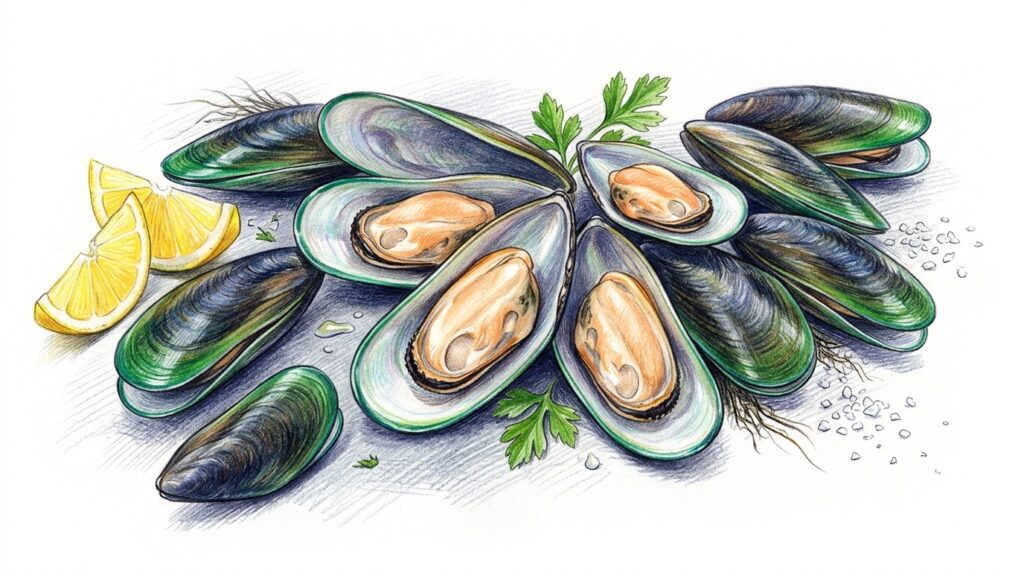
If you’re managing uric acid levels in New Zealand, mussels are a food you need to think about carefully.
They’re everywhere here. In chowders, on restaurant menus, piled up at fish markets, and steamed at every beach barbecue.
The problem? Mussels and uric acid don’t always mix well, because mussels are a high-purine shellfish.
But here’s where it gets interesting. Green-lipped mussels, the ones unique to New Zealand, have a twist that makes the conversation more nuanced than “just avoid them.”
Let’s break it down.
Regular Mussels: High in Purines
Standard mussels (blue mussels, Mediterranean mussels) are classified as a high-purine food. They contain roughly 112-170mg of purines per 100g serving, which puts them firmly in the “limit or avoid” category for anyone managing uric acid.
That’s in the same ballpark as sardines and anchovies. Not the worst offenders (organ meats take that crown), but high enough that regular consumption can push your uric acid levels in the wrong direction.
Why shellfish purines hit harder
Not all purines are created equal.
Shellfish like mussels are particularly high in adenine, a type of purine that raises uric acid more aggressively than other purine types. This is why seafood consistently shows up as a dietary risk factor for elevated uric acid in research.
The Green-Lipped Mussel Paradox
Here’s where it gets interesting for anyone living in New Zealand.
Green-lipped mussels (Perna canaliculus) are native to NZ waters and have been studied extensively for their anti-inflammatory properties. They contain a unique combination of omega-3 fatty acids, including eicosatetraenoic acid (ETA), that you don’t find in other shellfish.
The anti-inflammatory angle
Research shows green-lipped mussel extract can help reduce inflammation in joints and tissues. That’s relevant if you’re dealing with uric acid issues, because inflammation is a major part of what makes elevated uric acid so uncomfortable.
The paradox
Green-lipped mussels still contain purines. You’re getting the anti-inflammatory benefits alongside the purine load.
So you’re fighting inflammation with one hand while potentially raising uric acid with the other.
This doesn’t mean green-lipped mussels are off the table. It means you need to be smart about how and when you eat them.
Green-Lipped Mussel Extract vs Whole Mussels
There’s an important distinction here.
Green-lipped mussel extract (supplement form)
The extract, available as capsules or oil, concentrates the anti-inflammatory compounds while containing minimal purines. If you’re after the anti-inflammatory benefits without the purine load, this is the smarter option.
Whole green-lipped mussels (food)
Eating them steamed, in a chowder, or on the half shell means you’re getting the full purine content along with the anti-inflammatory properties. The purines don’t disappear just because the mussel has beneficial compounds.
How Much Is OK?
If your uric acid levels are well-managed and stable, an occasional serve of mussels (green-lipped or otherwise) is unlikely to cause problems.
Practical guidelines
- Stick to a small serving, around 6-8 mussels, no more than once a week
- Don’t combine mussels with other high-purine foods in the same meal
- Drink plenty of water before and after to support uric acid excretion
- If you’re in an active flare-up period, skip the mussels entirely until things settle
When to avoid mussels completely
- During or immediately after a uric acid flare
- If your levels are consistently elevated and you’re working to bring them down
- If you’re eating other high-purine proteins regularly (red meat, organ meats, other shellfish)
Better Protein Alternatives
If you’re looking for protein that won’t challenge your uric acid levels, there are much safer options.
- Eggs have virtually zero purines and are one of the safest proteins available
- Chicken breast (skinless) is moderate in purines and a practical everyday choice
- Dairy products are low in purines and may actually help lower uric acid
- White fish like snapper, gurnard, and tarakihi are much lower in purines than shellfish
The Bottom Line
Mussels are a high-purine food. That’s the reality.
Green-lipped mussels have genuine anti-inflammatory benefits that make them more interesting than regular mussels, but those benefits don’t cancel out the purine content.
If you enjoy mussels and your uric acid levels are under control, keep them as an occasional treat, not a regular feature.
And if you want the anti-inflammatory benefits of green-lipped mussels without the purine cost, look at the extract in supplement form instead.
For the full picture on which seafood works and which doesn’t, read our guide on seafood and uric acid. And for a broader view of what to eat, check out foods to support healthy uric acid levels.
Looking for support beyond what’s on your plate? URICAH combines 14 natural ingredients at transparent dosages to help maintain healthy uric acid levels. No proprietary blends. Over 2,200 customer reviews. Free overnight shipping across NZ, and a 90-day money-back guarantee.
This article is for informational purposes only and is not intended as medical advice. Consult your healthcare provider before making changes to your health routine.

URICAH! Uric Acid Support
4.85 / 5
read 2,294 customer reviews
$39 NZDTHIS IS YOUR URICAH MOMENT
URICAH provides natural support for healthy uric acid levels.
Our 14 potent, natural ingredients support the body’s normal uric acid levels, supporting joint mobility and function.
URICAH!™ features powerful ingredients used over many years to support healthy uric acid levels such as Tart Cherry, Celery Seed and Chanca Piedra.
LEARN MORE