
Most people with elevated uric acid are focused on their joints.
That’s where the pain is, so that’s where the attention goes.
But uric acid kidney stones and kidney damage are just as serious. High uric acid can damage your kidneys too. And when your kidneys are damaged, they become worse at removing uric acid.
Your levels climb higher. More kidney damage follows.
Understanding this cycle could be the most important thing you learn about managing your uric acid levels.
Your Kidneys Are Your Uric Acid Exit Route
About 70% of the uric acid your body produces is excreted through your kidneys.
They filter it out of your blood and pass it into your urine. That’s the primary way your body keeps levels in check.
When everything’s working properly, it’s a balanced system. Your body produces uric acid, your kidneys remove it, and levels stay within a healthy range.
The problem starts when that balance tips.
And it can tip in both directions.
How High Uric Acid Damages Your Kidneys
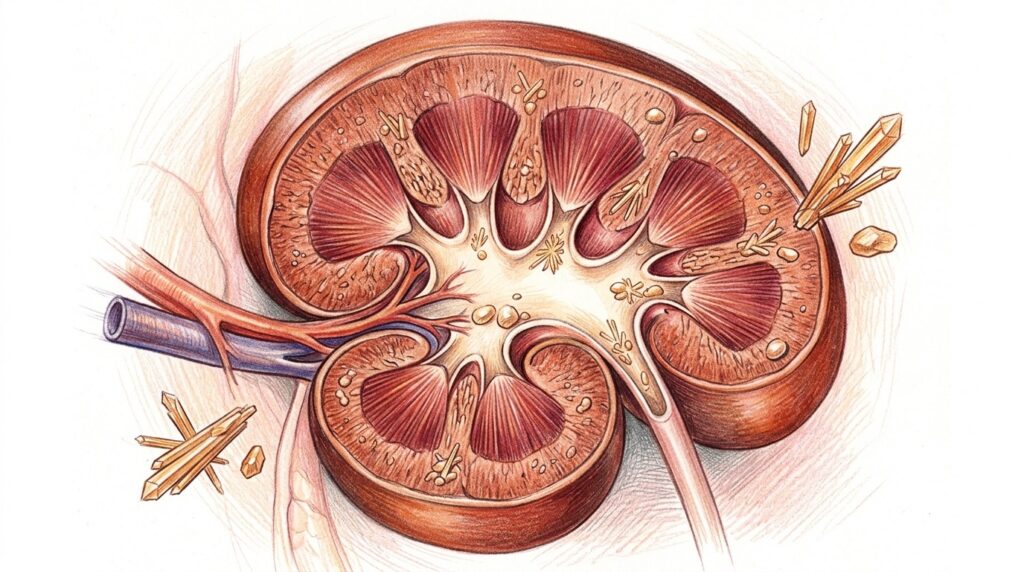
When uric acid levels stay elevated, crystals can form in your kidneys just as they do in your joints.
The damage happens in several ways.
1. Uric acid kidney stones
Uric acid can crystallise in the kidneys and form stones.
These are different from the more common calcium oxalate stones, though elevated uric acid can contribute to those as well.
Uric acid stones account for roughly 10% of all kidney stones. They form when urine is consistently acidic (low pH) and uric acid concentrations are high. Unlike calcium stones, they don’t always show up on standard X-rays, which means they can be missed.
The symptoms are the same as any kidney stone: severe flank pain, pain during urination, blood in the urine, nausea.
If you’ve had a kidney stone, you know it’s something you never want to repeat.
2. Urate nephropathy
This is when uric acid crystals deposit directly in the kidney tissue itself, rather than in the urinary tract.
Over time, these deposits cause chronic inflammation and can impair kidney function. It’s a slower, quieter form of damage than kidney stones, but potentially more serious because it’s progressive.
3. Inflammatory damage
Even without visible crystal formation, elevated uric acid triggers inflammatory and oxidative stress in kidney cells.
Research has shown that high serum uric acid is an independent risk factor for chronic kidney disease. The elevated levels alone can drive damage at the cellular level, no crystal formation required.
The Vicious Cycle Explained
This is the part that really matters.
Step 1:
Your uric acid levels are elevated.
Step 2:
High uric acid damages your kidneys (through crystals, inflammation, or both).
Step 3:
Damaged kidneys become less efficient at excreting uric acid.
Step 4:
Less excretion means uric acid levels rise further.
Step 5:
Higher levels cause more kidney damage.
And round it goes.
This cycle is why early action matters so much.
The longer elevated uric acid goes unmanaged, the harder it becomes to bring levels down. The very organs responsible for removing uric acid are being impaired by it.
Kidney function tests (eGFR, creatinine) should be part of your regular blood work if you’re dealing with elevated uric acid. You need to know how well your kidneys are performing, not just what your uric acid number is.
Uric Acid Kidney Stones vs Calcium Kidney Stones
The distinction matters for how you manage them.
Uric acid stones:
- Form when urine pH is consistently below 5.5 (acidic)
- Directly related to elevated serum uric acid
- Can sometimes be dissolved by alkalinising the urine (raising pH)
- Don’t always appear on X-rays (CT scan is more reliable)
- Account for about 10% of kidney stones
Calcium oxalate stones (most common):
- Form when calcium and oxalate concentrations are high
- More related to dietary calcium, oxalate intake, and hydration
- Cannot be dissolved once formed
- Show up clearly on X-rays
- Account for about 80% of kidney stones
Elevated uric acid can also promote calcium stone formation.
Uric acid crystals can serve as a “seed” for calcium oxalate crystals to form around. So even if your stone is primarily calcium, high uric acid may have contributed.
Signs Your Kidneys May Be Affected
Some warning signs that uric acid may be impacting your kidney health:
- Frequent kidney stones or gravel. If you’re passing small stones or sediment regularly, your kidneys are under stress.
- Changes in urination. Darker urine, reduced output, foamy urine, or increased frequency at night.
- Flank or lower back pain. Persistent or recurring pain in your side or lower back that isn’t muscular.
- Elevated creatinine on blood tests. This is a marker of reduced kidney function.
- Swelling in ankles or feet. When kidneys aren’t filtering properly, fluid can accumulate.
If you’re noticing any of these alongside known elevated uric acid, talk to your doctor.
Kidney function is something you never want to gamble with.
How to Support Your Kidneys
The good news is there’s plenty you can do to protect your kidneys while managing uric acid levels.
1. Hydration is non-negotiable.
Adequate water intake keeps urine dilute, which makes it harder for uric acid to crystallise.
Aim for at least 2-3 litres per day, more if you’re active, in a hot climate, or have a history of kidney stones.
Dehydration concentrates uric acid in your urine and drops your urine pH, creating perfect conditions for stone formation. Read more about dehydration and uric acid.
2. Support kidney function with targeted ingredients.
- Chanca piedra (the “stone breaker” herb) has been used for centuries for kidney support. Research shows it supports kidney stone prevention and healthy uric acid excretion. Read more about chanca piedra.
- Cranberry extract supports urinary tract health and may help maintain a healthy urinary pH.
- Celery seed extract has natural diuretic properties that support uric acid excretion through increased urine flow.
3. Monitor your urine pH.
You can buy pH test strips from any chemist.
Uric acid stones form in acidic urine (below 5.5). Keeping your urine pH between 6.0 and 7.0 significantly reduces stone risk. Dietary changes, hydration, and certain supplements can help with this.
4. Reduce purine load.
The less uric acid your body has to process, the less strain on your kidneys.
Managing high-purine foods is part of this equation. Learn about uric acid levels.
5. Limit alcohol and fructose.
Both increase uric acid production and can impair kidney excretion. Alcohol and fructose are a double hit.
When to See a Doctor
Managing uric acid naturally is sensible and practical.
Kidney involvement is the point where you need professional oversight.
See your doctor if:
- You’ve passed a kidney stone or suspect you have one
- Your blood work shows elevated creatinine or declining eGFR
- You have persistent flank pain or urinary changes
- Your uric acid levels are consistently above 0.42 mmol/L (7 mg/dL) despite lifestyle changes
- You have a family history of kidney disease
Kidneys don’t regenerate. Once function is lost, it doesn’t come back.
Early monitoring and intervention make a real difference.
The Bottom Line
High uric acid is a kidney problem just as much as a joint problem.
The relationship runs both ways: elevated uric acid damages kidneys, and damaged kidneys drive uric acid higher.
Breaking that cycle requires a two-front approach. Reduce uric acid levels through diet, lifestyle, and targeted supplementation. And actively support kidney function through hydration, kidney-supporting ingredients, and regular monitoring.
Your kidneys are doing the heavy lifting. Give them what they need.
URICAH contains chanca piedra, cranberry, celery seed, and other kidney-supporting ingredients alongside uric acid management compounds. 14 clearly labelled ingredients. No proprietary blends.
See the full URICAH ingredient list
Try URICAH with a 90-day money-back guarantee
This article is for informational purposes only and is not intended as medical advice. Consult your healthcare provider before making changes to your health routine.

URICAH! Uric Acid Support
4.85 / 5
read 2,294 customer reviews
$39 NZDTHIS IS YOUR URICAH MOMENT
URICAH provides natural support for healthy uric acid levels.
Our 14 potent, natural ingredients support the body’s normal uric acid levels, supporting joint mobility and function.
URICAH!™ features powerful ingredients used over many years to support healthy uric acid levels such as Tart Cherry, Celery Seed and Chanca Piedra.
LEARN MORE