
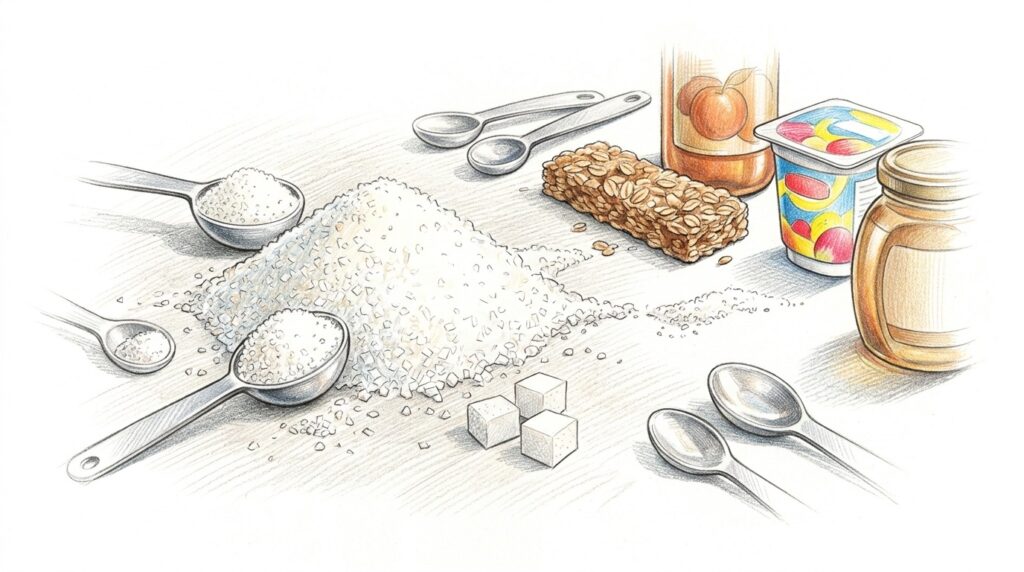
Does sugar raise uric acid? Yes, and it’s the factor most people completely overlook.
Everyone focuses on purines – red meat, shellfish, organ meats, beer. That’s where all the attention goes.
But there’s something else driving your uric acid levels up that barely gets mentioned. Fructose.
And the fructose and uric acid connection is stronger than most people realise.
The real problem isn’t the sugar you know you’re eating. It’s the sugar you don’t.
How Sugar Increases Uric Acid
This isn’t complicated, but it is important.
When your body metabolises fructose, it generates uric acid as a direct byproduct. Not over hours. Within minutes. Your liver breaks down fructose and produces uric acid as part of that process, fast.
But it gets worse. Fructose doesn’t just increase uric acid production. It also limits your body’s ability to excrete it. So you’re making more and clearing less.
That’s the worst combination possible if you’re trying to keep your levels in check.
This is why people who “eat healthy” but load up on fruit juice, flavoured yoghurts, and so-called health foods can still have stubbornly high uric acid levels. The sugar is doing the damage, and they don’t even realise it.
The “Fat-Free” Trap
This is one of the biggest cons in the supermarket, and most people fall for it.
When food manufacturers remove fat from a product, it tastes terrible. Nobody wants to eat cardboard. So they replace the fat with sugar. Lots of it. The label says “fat-free” or “trim,” and you think you’re making a healthy choice. You’re not.
Let’s look at a real example that will probably annoy you.
Anchor Trim Milk vs Full-Fat Blue Top
Anchor Trim milk contains 12.4g of sugar per 100ml.
Anchor Blue (full-fat) milk contains 4.8g of sugar per 100ml.
Read those numbers again. The “healthy” trim option has nearly three times the sugar of the full-fat version.
Now do the maths on a normal morning. Say you have 350ml of trim milk across your cereal and a couple of cups of tea. That’s 43.4g of sugar. Before you’ve even left the house.
The recommended daily sugar limit? 30g.
You’ve blown through it at breakfast. With milk.
This is the problem. People are making choices they think are smart and getting punished for it. The food industry has spent decades telling us that fat is the enemy. Meanwhile, sugar is quietly driving up uric acid levels, fuelling inflammation, and contributing to weight gain, all of which make uric acid issues worse.
Hidden Sugar in “Healthy” Foods
Milk is just the start. Once you start reading labels, you’ll find sugar hiding in places that have no business containing it.
Yoghurt
Flavoured yoghurts are some of the worst offenders. A single pottle can contain 15-20g of sugar. Even “natural” or “high protein” varieties often have added sugar. Check the label every time.
Salad dressing
You make a healthy salad, then drown it in a dressing that contains more sugar per serve than a biscuit. Most commercial dressings are loaded with sugar. Make your own with olive oil and vinegar instead.
Peanut butter
The cheap, mainstream brands add sugar. Sometimes a lot of it. Look for peanut butter with one ingredient: peanuts. Fix & Fogg and Pic’s are good NZ options.
Spreads and condiments
Tomato sauce, BBQ sauce, sweet chilli, mayo. They all contain sugar. Some of them are essentially sugar with flavouring.
Breakfast cereals
This is where it gets truly eye-opening.
- Nutri-Grain: 26.7g of sugar per 100g
- Froot Loops: 38g of sugar per 100g
- Just Right: 22.9g of sugar per 100g
Just Right. The cereal with the health-conscious branding and the wholesome imagery on the box. Nearly a quarter sugar by weight.
If you’re eating cereal for breakfast and adding trim milk, you could easily be consuming 50-60g of sugar before 8am. That’s almost double the recommended daily limit. For breakfast.
Fruit Juice Isn’t the Answer Either
“But it’s natural sugar.” You hear this constantly. And it’s irrelevant.
Your body doesn’t care whether the fructose came from a mango or a Coca-Cola. The metabolic process is the same. Fructose hits your liver, uric acid gets produced. That’s how it works.
Here are the numbers.
Coca-Cola: 10.6g of sugar per 100ml.
Orange juice: 9.6g of sugar per 100ml.
Look at that. Orange juice has almost as much sugar as Coca-Cola.
A 300ml glass of OJ gives you nearly 29g of sugar in one hit. That’s almost your entire daily limit from a single glass of something most people consider healthy.
Whole fruit is different. When you eat an actual orange, you’re getting fibre, which slows down the absorption of fructose and reduces the metabolic impact. But once you juice it, you strip out the fibre and concentrate the sugar. A glass of OJ might contain the juice of four or five oranges. You’d never sit down and eat five oranges in one go.
Why Sugar Is So Hard to Quit
Here’s something that might surprise you. Research has shown that sugar activates the same dopamine reward pathways in your brain as heroin. The same ones.
That’s not an exaggeration for effect. It’s neuroscience.
When you eat sugar, your brain releases dopamine, the “feel good” chemical. Over time, your brain adjusts and needs more sugar to get the same response. That’s the definition of addiction.
This is why you crave sweet things. It’s why cutting sugar feels genuinely difficult. It’s why you can tell yourself “I’ll just have one” and end up finishing the packet. Your brain is wired to seek it out, and the food industry knows this.
They engineer products to hit that sweet spot. Literally.
Understanding this doesn’t make it easy, but it does explain why willpower alone often isn’t enough. You need a strategy, not just good intentions.
What You Can Actually Do
Right. Enough about the problem. Here’s the practical bit.
Read every label
This is non-negotiable. Turn the packet around and look at the sugar content per 100g. Not per serve, because serving sizes are set by the manufacturer and are often unrealistically small. Per 100g gives you a fair comparison across products.
Target under 5g per 100g
As a general rule, anything under 5g of sugar per 100g is a reasonable choice. Between 5g and 15g, be cautious. Over 15g, put it back on the shelf.
Stick to 30g of sugar per day
This is the commonly recommended daily limit. Once you start tracking, you’ll realise how quickly you hit it. Most New Zealanders consume well over double this without realising it.
Limit fruit to 1-2 portions per day
Fruit is fine in moderation. It contains fibre, vitamins, and antioxidants. But stick to one or two portions of whole fruit per day. No juice. No dried fruit (which concentrates the sugar). No smoothies with five different fruits blended together.
Berries, kiwifruit, and citrus are among the better choices. For details, see our guide on the best fruits for uric acid. They’re lower in fructose compared to things like grapes, mangoes, and bananas.
Swap your breakfast
If you’re eating cereal with trim milk, you’re starting your day with a sugar bomb.
Switch to eggs, porridge with whole milk and a handful of berries, or wholegrain toast with avocado. These options keep you fuller for longer and don’t spike your uric acid first thing in the morning.
For more on how avocado fits into a uric acid-friendly diet, read our guide on uric acid and avocado.
Drink water, not sugar
Soft drinks are obvious. But fruit juice, flavoured water, sports drinks, and even some “health” drinks are loaded with sugar. Water is what your kidneys need to flush uric acid efficiently. Keep it simple.
If plain water bores you, check out our tips on how to drink more water without resorting to sugary alternatives.
The Bottom Line
Sugar is one of the most overlooked drivers of high uric acid. It increases production, limits excretion, hides in foods marketed as healthy, and is genuinely addictive.
You don’t need to be perfect. But you do need to be informed.
Start reading labels. Cut the obvious offenders. Be suspicious of anything labelled “fat-free” or “trim.” And stop treating fruit juice like it’s a health drink.
Your uric acid levels will thank you for it.
This article is for informational purposes only and is not intended as medical advice. Consult your healthcare provider before making changes to your health routine.

URICAH! Uric Acid Support
4.8 / 5
read 2,447 customer reviews
$39 NZDTHIS IS YOUR URICAH MOMENT
URICAH provides natural support for healthy uric acid levels.
Our 14 potent, natural ingredients support the body’s normal uric acid levels, supporting joint mobility and function.
URICAH!™ features powerful ingredients used over many years to support healthy uric acid levels such as Tart Cherry, Celery Seed and Chanca Piedra.
LEARN MORE